


In recent years, the theme of Diversity, Equity, and Inclusion (DE&I) has assumed a central role in the strategic evolution of organizations. These are no longer fringe initiatives or programs intended exclusively for human resources, but real ones cultural pillars to build work environments that respect and value each individual.
In recent years, adopting an inclusive vision means investing in growth, in the competitiveness and sustainability of the company.
According to the “Randstad Employer Brand Research” report:
- For the 45% of the interviewees, a company's commitment to DE&I issues is a priority criterion when choosing an employer;
- The8.7% identifies the lack of inclusive values as one of the main motivations for changing jobs, a percentage that rises to 14% among the younger generations.
These data clearly show that DE&I is no longer an option, but a strategic need, regardless of the sector or size of the organization. Integrating diversity, equity and inclusion into internal processes means creating value for people and promoting a full corporate sustainability.
What are diversity, equity and inclusion policies
When we talk about Diversity, Equity & Inclusion (DE&I) we refer to the set of business strategies, policies and practices designed to ensure rights, respect and equal opportunities to all people, valuing their differences instead of considering them an obstacle.
The most frequently considered dimensions include:
- gender;
- age;
- ethnicity and cultural background;
- religion;
- ideological orientation;
- psycho-physical abilities and conditions;
- sexual orientation.
These three concepts, diversity, equity and inclusion, are often referred to as a single block, but they have Distinct meanings. Understanding them in their specificity is essential to define concrete actions, appropriate measures and a company culture truly attentive to people's well-being.
What do the terms diversity, equity and inclusion mean
The initials DE&I contain three fundamental concepts to build equitable, innovative work environments that promote a full social sustainability.
Although closely connected, diversity, equity and inclusion describe different dimensions, which together make it possible to reduce internal imbalances and promote a fairer and more participatory corporate culture. Let's look at them in detail.
1. Diversity: Recognizing Differences
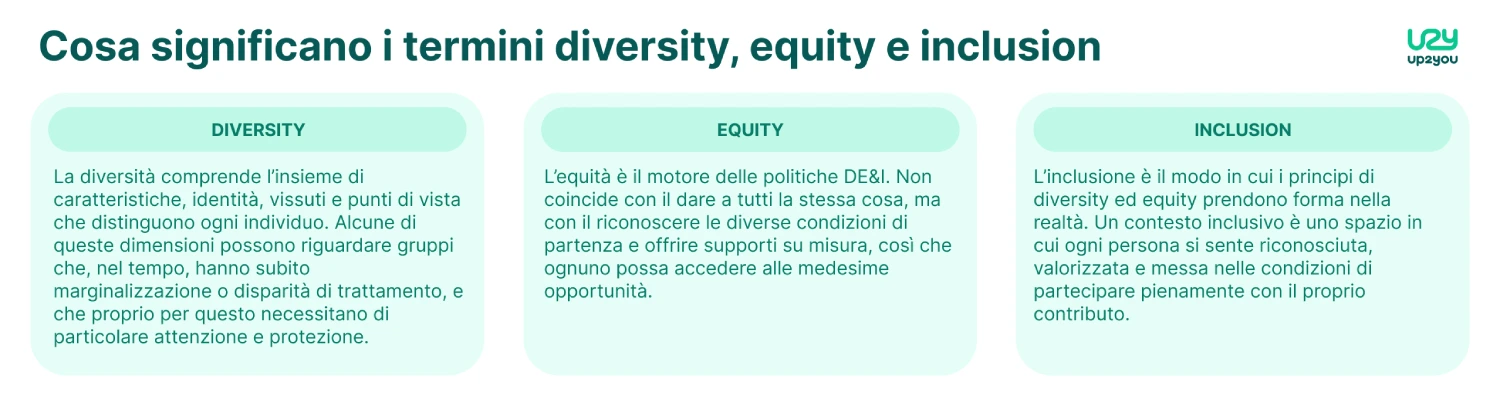
Diversity is about the characteristics, identities, experiences and perspectives that make each person unique.
Some of these differences belong to historically minority or discriminated against groups, and for this reason they require greater protection.
The main dimensions of diversity include:
- age;
- gender and gender identity;
- sexual orientation;
- ethnic origins and cultural background;
- religion;
- political orientation;
- physical, sensory, or cognitive abilities;
- socio-economic status.
In the complexity of contemporary society, these dimensions are often intertwined, generating multiple identities: people who combine two cultures, two languages and a heritage of values that can significantly enrich the business environment.
2. Equity: guarantee the right conditions, not the same
Equity is at the heart of DE&I policies. It doesn't mean treating everyone equally, but recognize the different starting conditions and guarantee personalized tools so that everyone can have the same opportunities.
Promoting equity means:
- eliminate structural or cultural barriers;
- guarantee equal access to growth paths;
- offer differentiated supports when necessary;
- reduce power imbalances between different groups.
Equality is a goal, but equity is the method to achieve it in a realistic and sustainable way.
3. Inclusion: turning differences into participation
Inclusion is what makes the principles of diversity and equity concrete.
Un inclusive environment It is a place where every person feels welcomed, respected and put in a position to contribute actively.
Include means:
- facilitate the inclusion and participation of everyone;
- listen to needs, expectations and critical issues;
- create safe spaces for discussion;
- value the plurality of points of view;
- make sure that each person perceives that they really belong to the group.
When diversity, equity and inclusion work together, diversity becomes innovation, complexity becomes a resource and the contribution of each person becomes business value.
What does inclusive organization mean
An organization can be defined as truly inclusive when it not only recognizes the diversity of people, but considers it a strategic value to be integrated into their culture.
An inclusive organization:
- does not fear diversity, but welcomes and values it, allowing everyone to express their identity with authenticity;
- actively counteracts stereotypes, prejudices and discrimination, acting proactively to prevent and manage harmful dynamics;
- deal with conflicts responsibly, recognizing that differences can generate tensions, but also opportunities for comparison and growth.
An important aspect, often underestimated, is the organization's ability to make difficult decisions to protect collective well-being. In a truly inclusive context, this also means intervene and possibly remove those who generate intractable conflicts, while maintaining a fair and respectful approach.
The goal is to safeguard a healthy, collaborative and safe work environment for everyone.
But inclusion is not only about diversity management: it is a daily commitment that is reflected in the internal practices, values and structure of the organization itself.
An inclusive company, in fact:
- guarantees dignity and respect to all people, regardless of role or seniority;
- ensures fair pay and transparent policies on growth paths;
- promotes a real balance between private and work life, recognizing the value of individual well-being;
- promotes active participation in decision-making processes, allowing every voice to be heard, considered and valued.
An inclusive organization is therefore an open, dialogic and responsible ecosystem. It is a place where differences are not simply tolerated, but transformed into resources that enrich culture, improve collaboration and fuel innovation.
The 5 ways to promote DE&I policies in the company
Promoting diversity, equity and inclusion in the company means go beyond symbolic initiatives or isolated interventions.
DE&I must become an integral part of organizational culture, a lens through which to rethink processes, relationships and decisions. To do this, vision, consistency and a strong commitment on the part of all people are needed, starting with leadership.
1. Building a DE&I strategy consistent with the corporate identity
The first step is to define a clear strategy aligned with the organization's values and objectives. DE&I cannot be confined to HR, but it must enter into governance, products and services, communication, relationships with stakeholders and partners, purchasing policies and daily activities. Transparency about commitments and results is crucial for measuring progress.
2. Integrating DE&I into culture at all levels
To have a real impact, DE&I must be experienced daily by every team, not just promoted by top management. It means incorporating inclusive principles into people's mindset and ensuring consistency between what the company communicates and what it practices. Leadership, in particular, has the task of driving change with responsibility and continuity.
3. Align business initiatives and objectives
The activities related to DE&I must be part of the company's long-term strategy, avoiding sporadic or unrelated interventions. Defining clear, measurable and consistent priorities with general objectives makes it possible to guide choices and maximize the impact of initiatives.
4. Review talent acquisition processes
The selection and management of talent represent one of the areas in which DE&I can generate immediate results. For this reason, it is necessary to rewrite job descriptions free of bias, expand search channels, adopt fair selection criteria and build inclusive onboarding paths. The goal is to attract and enhance different profiles, not just to introduce new people.
5. Train and sensitize managers and employees
Training is an essential tool for transforming awareness into concrete behavior. Programs dedicated to unconscious bias, inclusive communication, equitable leadership, conflict management, and social responsibility help people recognize stereotypes, improve interactions and actively contribute to corporate culture.
The 5 advantages of working in a more inclusive company
Working in an inclusive company means operating in a context where diversity, equity and respect are not only declared principles, but concrete practices that they improve people's lives and the performance of the organization. The benefits go far beyond the economic plan: they concern corporate culture, the ability to innovate, the well-being of people and the creation of value in the long term.
1. More innovation and adaptability
In a heterogeneous environment, different ideas, perspectives and approaches emerge more easily. The plurality of points of view stimulates innovation, makes teams more ready to read market changes and allows the organization to better respond to the new needs of people and customers. In a constantly evolving global context, this flexibility becomes a competitive advantage real.
2. Greater well-being and psychological security
An inclusive company is a place where people feel heard, treated fairly, and recognized for their contribution. This reinforces psychological security, an essential condition for participating, collaborating and reducing the so-called minority stress that affects those who belong to minority groups, with negative effects on well-being and productivity. Management attentive to merit and fairness thus builds a lasting climate of trust.
3. Increased attractiveness and ability to retain talent
DE&I policies improve the company's reputation and make it more interesting for professionals and stakeholders sensitive to ESG topics. An inclusive organization attracts talent from wider pools, increases the representation and quality of skills and promotes retention, because a fair and welcoming environment reduces turnover and dissatisfaction. More and more people are choosing workplaces aligned with their values and growth expectations.
4. Increased productivity, performance and business results
Research shows a direct link between inclusion and performance. An effective approach to DE&I generates more engaged and goal-oriented teams, more collaborative working relationships and stronger decision-making processes thanks to the diversity of perspectives. The result is a positive impact on productivity, turnover and ability to innovate: when everyone can express their best, the entire organization benefits.
5. A stronger and more sustainable company culture
A company that truly values people listens to them, recognizes and supports their contributions, invests in their development and cultivates an authentic sense of belonging. Working in a context of this type becomes a source of pride and pushes people to commit themselves with greater conviction to achieving common objectives, transforming them into ambassadors of corporate culture even outside.