Product carbon footprint and LCA analysis

Why is it important to calculate the product's carbon footprint?


Our solution for calculating the product's carbon footprint
Structured data collection
Calculation of emissions
Reporting
Certification support
EPD: we carry out the LCA study and guide you in obtaining the EPD environmental product declaration.
A single platform for calculating and monitoring your emissions
With the Climax module of the Up2You Platform, you can calculate and monitor the CO2 emissions of your product or service.
Discover Climax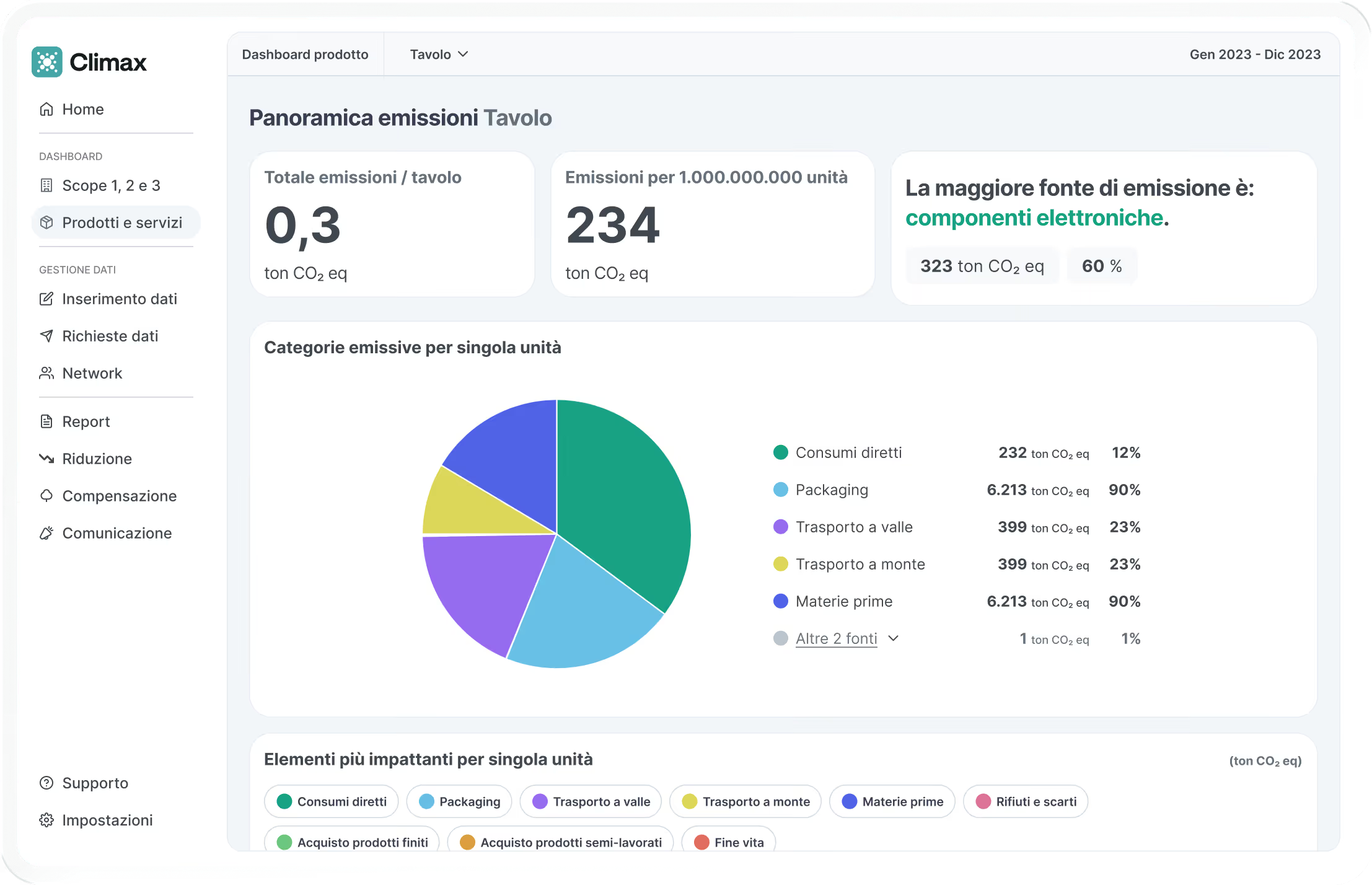


Get ongoing support from a qualified team

The results achieved by the companies that chose us
What is a product carbon footprint?

The product carbon footprint is the measurement of CO₂ equivalent emissions generated during a product's life cycle, from production to disposal. It is calculated according to standards such as ISO 14067 and the EU's Product Environmental Footprint (PEF) guidelines.
What is the purpose of calculating a product carbon footprint?
The product carbon footprint is used to:
- quantify the environmental impact of a specific product;
- obtain environmental labels (e.g., EPD – Environmental Product Declaration);
- respond to requests from B2B clients and retailers who are increasingly focused on sustainability;
- support eco-design and the improvement of the production cycle.
Which stages does the product carbon footprint calculation consider?
The product carbon footprint calculation takes into account all stages of a product's life cycle, from its origin to its disposal. This approach allows for the precise measurement of the overall impact associated with the product.
The stages included are:
- raw material extraction: analyzes the impact derived from the extraction, cultivation, or harvesting of resources needed for production (e.g., metals, plastic, wood, textile fibers);
- production and transport: evaluates the emissions generated during industrial processing and the movement of the product between facilities, suppliers, and warehouses;
- distribution and use: considers the energy consumed for logistics to the end customer and, if relevant, the emissions produced during the product's use by the user;
- end-of-life: includes the disposal, recycling, or reuse phase.
What is the difference between product carbon footprint and organizational carbon footprint?
- product carbon footprint focuses on calculating the CO2 equivalent emissions associated with the life of a single good or service. It includes all emissions generated throughout the various stages of the product's life cycle: from production to distribution, and from use to disposal. It is particularly useful for companies that want to communicate the sustainability of a specific product (e.g., through EPDs or environmental labeling), participate in public tenders or green grants, or respond to transparency requests from B2B clients or international retailers;
- organizational carbon footprint analyzes the emission impact of all company activities as a whole, considering headquarters, offices, production processes, internal logistics, procurement, mobility, etc. It is the ideal tool for defining an integrated corporate ESG strategy, monitoring and reducing Scope 1, 2, and 3 emissions, aligning with standards required by the CSRD, SBTi, or sustainability reports, and communicating climate commitment credibly to stakeholders, investors, and employees.
Is product carbon footprint certification mandatory?
No, but it is strongly recommended in many sectors, especially for participating in public tenders, obtaining environmental labels (EPD), or aligning with the requirements of international stakeholders.