Up2You and Campania Startup 2023
The initiative, co-financed by the European Union, the Italian State, and the Campania Region under the PR Campania FESR 2021-2027, was created to address one of the most complex challenges of modern sustainability: the calculation and management of Scope 3 emissions.
Why the focus on Scope 3?
While Scope 1 (direct) and Scope 2 (indirect from energy) emissions are often under a company's immediate control, Scope 3 represents the greatest challenge, accounting on average for over 80% of the total carbon footprint. These emissions include the entire value chain: from the extraction of raw materials by suppliers to the end-of-life of sold products.
Thanks to this project, CliMax has been enhanced to allow companies to:
Map emission categories defined by the GHG Protocol, precisely identifying upstream and downstream impacts.
Overcome data complexity: the platform facilitates the collection of primary data from suppliers, reducing reliance on generic estimates and increasing calculation accuracy (supplier-specific method).
Obtain validated reports: CliMax technology is validated by third-party bodies such as RINA, ensuring that the reporting produced is ready for audits and certified sustainability reports.


What is CliMax?


Calculating Scope 3 emissions
What makes up a company's carbon footprint?
Often, the focus is on emissions derived from industrial processes, overlooking all activities that take place outside the company perimeter, such as raw material procurement, transportation, final product distribution, usage phase, and disposal.
However, emissions produced within the company's scope represent only a fraction (on average less than 20%) of total emissions.
To fully understand an activity's impact on climate change, it is necessary to include all emissions generated downstream and upstream in the value chain: in other words, it is necessary to calculate Scope 3.
Scope 1, 2, 3: what are the emission scopes
According to the GHG Protocol, the international standard for calculation, emissions are divided into 3 scopes based on their origin.
- Scope 1: these are direct GHG (Greenhouse Gas) emissions from sources owned or controlled by an organization. Examples include emissions related to the use of fossil fuels within a facility, combustion from owned or leased vehicles, and those resulting from refrigerant gas leaks.
- Scope 2: these are indirect emissions resulting from the generation of electricity, heat, and steam purchased and consumed by the organization. These emissions are considered indirect because the company is responsible for the energy usage, but not for the emissions generated by the supplier during its production.
- Scope 3: these are indirect GHG emissions, excluding those from electricity, heat, and steam. This category encompasses emission sources that are not under the company's direct control, but whose emissions are indirectly linked to the company's activities. Scope 3 includes emissions upstream and downstream in the value chain, i.e., those produced by suppliers and customers.
Scope 3: which emission categories are included
Scope 3 emissions are classified into 15 categories. It is important to note that not all companies are required to report on all 15, as some may not be relevant to the specific nature of the company's activities or its operational context.
Therefore, the first step in a Scope 3 emissions study is a materiality assessment, aimed at identifying the emission sources relevant to the specific business.
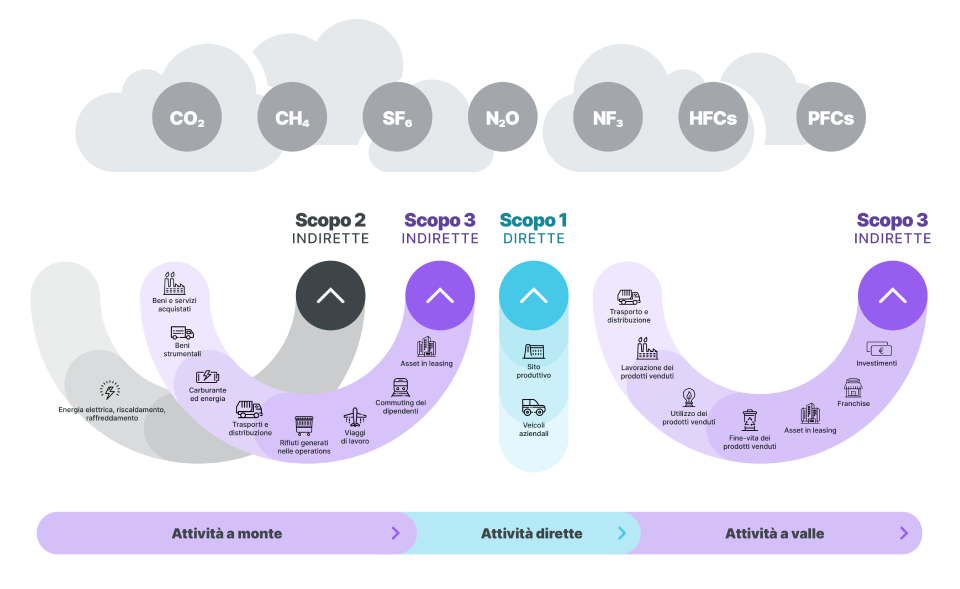
The 15 Scope 3 categories are detailed below.
- Purchased goods and servicesThis category quantifies both the emissions resulting from the production of goods purchased by the company and the impact of services acquired from external suppliers. It therefore includes emissions related to raw materials, intermediate goods, and finished products purchased.
- Capital goods: emissions generated by the production of capital goods (such as buildings or machinery) acquired in the reporting year are calculated.
- Fuel- and energy-related activities:includes emissions resulting from fuel and energy purchased by the company and not included in Scope 1 or 2, such as the extraction, production, and transport of purchased fuels and energy.
- Upstream transportation and distribution:includes emissions associated with the transport of goods and services purchased by the company, carried out using vehicles not owned by the company.
- Waste generated in operations:emissions generated by the disposal, treatment, and transport of waste carried out by third parties are quantified.
- Business travel:emissions associated with business travel by staff are calculated, i.e., the impact generated by the means of transport used (excluding those made with company vehicles) to travel to a client, a supplier, or an event.
- Employee commuting:emissions resulting from employee commuting from their homes to the workplace are reported.
- Leased assets:includes emissions linked to leased assets, the consumption of which has not already been reported in Scope 1.
- Downstream transportation and distribution:includes emissions linked to the transport of goods sold by the company using third-party vehicles (not owned by the company), such as shipping a product sold online via courier.
- Processing of sold products:includes emissions resulting from the processing of sold goods by third parties.
- Use of sold products:accounts for emissions resulting from the use of the sold product. For example, for a company that sells smartphones, the emissions linked to the electricity consumption required to use the device are attributed to it.
- End-of-life of sold products:these emissions come from the disposal and end-of-life treatment of products sold by the company.
- Leased assets:includes emissions related to leased assets where consumption has not already been reported under Scope 1.
- Franchises:quantifies emissions resulting from franchising one's brand, which involves granting third-party companies the license to sell or distribute one's goods or services.
- Investments:considers emissions generated by companies within one's investment portfolio. Emissions generated by the activities in which one has invested are adjusted based on the share of capital invested and the duration of the holding within the portfolio.
The listed categories refer to the international GHG Protocol standard; however, this classification is not universal.
Calculate your carbon footprint
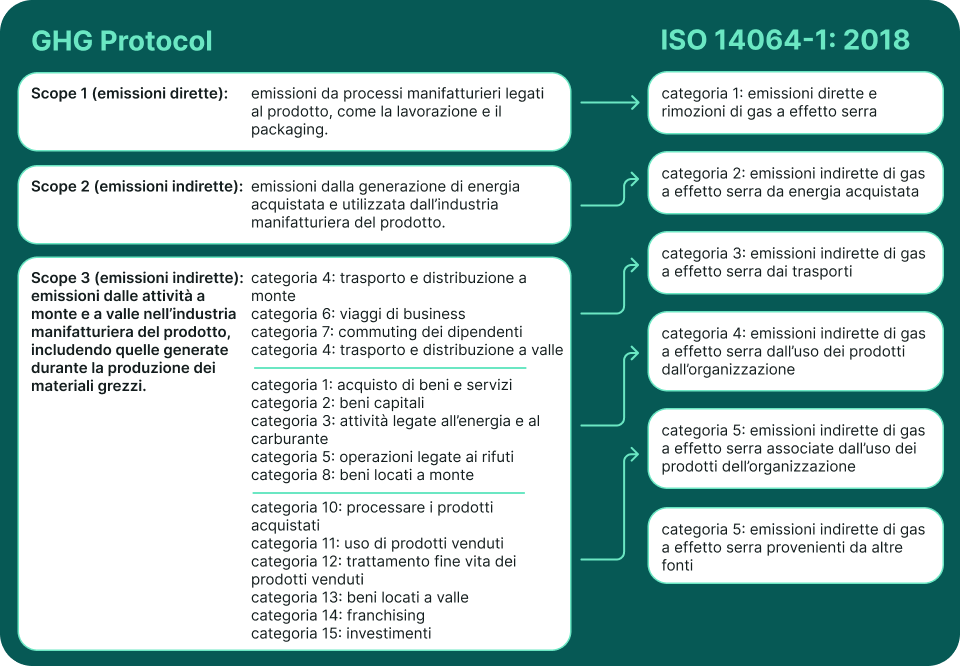
Scope 3 categories according to the ISO 14064 guidelines
The ISO 14064 guidelines use a slightly different breakdown: in this standard, emissions are divided into 6 categories.
Category 1. Direct GHG emissions and removals:
- Scope 1.
Category 2. Indirect GHG emissions from imported energy:
- Scope 2.
Category 3. Indirect GHG emissions from transportation:
- upstream transportation and distribution;
- business travel;
- commuting;
- downstream transportation and distribution.
Category 4. Indirect GHG emissions from products used by the organization:
- purchased goods and services;
- capital goods;
- fuel- and energy-related activities;
- waste generated in operations;
- leased assets.
Category 5. Indirect GHG emissions associated with the use of products from the organization:
- processing of sold products;
- use of sold products and services;
- end-of-life treatment of sold products;
- leased assets;
- franchises;
- investments.
Category 6. Indirect GHG emissions from other sources:
- specific emissions that cannot be placed in any other category. It is the organization's responsibility to define the content of this particular category.
What is the impact of Scope 3?
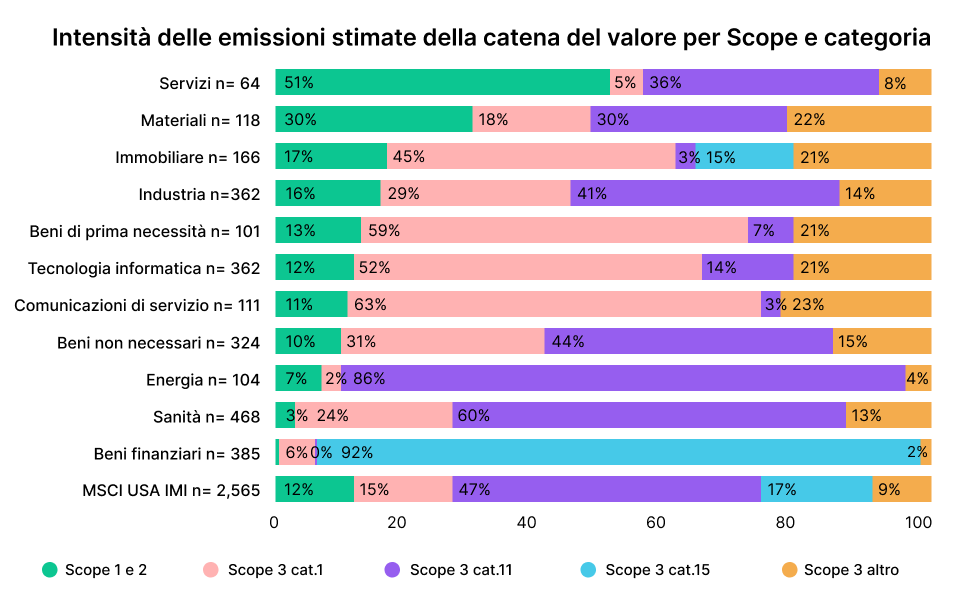
It is quite common for two companies operating in the same sector to have a similar emissions breakdown; however, the distribution of emissions varies significantly from sector to sector.
Let us analyze, for example, two cases that highlight the different relevance of Scope 3 emission categories.
A financial institution's Scope 3 emissions
A financial institution's emissions are often linked to its financial management activities; consequently, over 90% of emissions come directly from investments.
The weight of this category varies depending on the volume of investments made and the sectors in which the financial institution operates.
Scope 3 emissions of a company in the energy sector
For companies operating in the energy sector, however, most emissions come from the combustion of fossil fuels sold, such as fuels used by internal combustion engine vehicles and gas used for home heating.
These two examples demonstrate how much the emission breakdown can vary depending on a company's core business. Below is a summary chart of the distribution of emissions by sector.
How to calculate Scope 3 emissions
After identifying the relevant emission categories for a given company, you can move on to the practical part, which is the quantification of emissions. Emissions related to each emission source are calculated using the following formula:
GHG emissions = Primary data * Emission factor
Primary data are measurements available from the company: they can refer, for example, to the mass in kg of a purchased product, or the distance traveled for the transport of a good sold to the final customer.
Emission factors are coefficients that allow for the determination of CO2 eq. emissions based on primary data.
Depending on the information available, you can quantify the emissions of the various Scope 3 categories by applying one of the following methods.
- Spend-based: this methodology considers monetary inputs obtained from accounting records recorded during the fiscal year as primary data.
This approach is the simplest for calculating a Scope 3 category; however, the emission factors used are generic and consequently significantly reduce the accuracy of the calculation.
- Average data: reports emissions using emission factors derived from literature studies. In this case, the primary data may refer to the quantity of material purchased (a weight in kilograms or the unit value of goods purchased).
This approach offers greater accuracy than the spend-based method, but acquiring primary data can be less accessible and requires precise collection.
- Supplier-specific data: the calculation is performed using a study provided directly by the supplier as an emission factor, relating to the specific product purchased, such as a product carbon footprint or an LCA (Life Cycle Assessment).
This approach allows for the highest degree of accuracy, but only a small percentage of products available on the market can provide this type of information.
- Hybrid method:the calculation is performed using a hybrid mode, combining "average data" and "supplier-specific data."
The accuracy of this methodology varies depending on the primary approach used: if the calculation is performed mainly using "supplier-specific data," it will have high accuracy; conversely, accuracy decreases if the "average data" mode is used predominantly.
Sources