

What are the ESRS standards
The ESRS (European Sustainability Reporting Standards) are the European principles established for preparing sustainability reports in accordance with the CSRD (Corporate Sustainability Reporting Directive). Their purpose is to define a consistent and verifiable framework for measuring environmental, social, and governance (ESG)performance, making corporate data easily comparable across the European Union.
While the CSRD establishes the regulatory framework and identifies who must report, the ESRS translate these obligations into practice: they specify what information to collect, how to organize the report structure, and which calculation methodologies to use. The technical development of the standards is entrusted to theEFRAG (European Financial Reporting Advisory Group), which develops the texts and application guidelines on key aspects such as double materiality and value chain, while the European Commission is responsible for their formal regulatory transposition.
The ESRS model is based on double materiality, requiring companies to analyze both theimpact generated externally on people and the environment, and the risks and opportunities related to sustainability that may affect the company's economic-financial performance and business continuity. For this reason, the figures presented in the report must always be accompanied by contextual elements that clarify their methodology, scope, and connection to corporate policies.
Following the revisions introduced by the Omnibusreform, the scope of companies required to apply the ESRS has been redefined. The obligation now applies to:
- EU companies that simultaneously exceed more than 1,000 average employees and over 450 million euros in net turnover;
- the non-EU companies with a global turnover exceeding 450 million euros within the EU market, or with subsidiaries and branches in European territory that generate at least 200 million euros.
A further evolution occurred with the new simplified version adopted by the European Commission in July 2026, which has reduced mandatory data points by approximately 60% compared to the original framework, easing the operational burden on businesses. It remains essential for organizations to act in advance, defining responsibilities, sources, and data collection workflows throughout the year to avoid concentrating the workload in the final weeks before publication.
What the new ESRS standards entail
The revision adopted by the European Commission on July 3, 2026, marks a decisive shift in the application of the ESRS. Created to replace the initial 2023 version, the new standards will become mandatory for financial years starting from January 1, 2027, with the option for companies to apply them early, starting with the 2026 financial statements.
The goal of the update, which continues the Omnibus reform, is to drastically reduce the bureaucratic burden and compliance costs for businesses, estimated to be down by over 30%, without undermining the significance of the double materiality analysis.
The main innovations of the new framework are as follows.
Significant reduction in required data
The new ESRS eliminate over 60% of mandatory data points and more than 70% of total data points (including previous optional disclosures). Many requirements have been merged or rewritten to avoid overlap, focusing attention only on what is truly useful for investors and stakeholders.
More pragmatic financial assessment
In the 2023 version, estimating the economic impact of variables such as biodiversity, water resources, or pollution in monetary terms proved to be a complex exercise. Specific thematic requirements on these topics have been removed; the general obligation in ESRS 2 remains, but with the option to provide primarily qualitative analysis where quantification is uncertain or too burdensome. The only exception is climate (ESRS E1), which continues to require precise data on physical and transition risks.
Top-down double materiality
The analysis process shifts perspective, adopting a top-down approach. It is up to company management to identify and justify relevant issues based on a real understanding of the business, sector, geographical areas, and value chain. The option to combine both approaches in the same assessment remains: top-down for some topics, bottom-up for others, depending on what is most suitable on a case-by-case basis.
Flexibility regarding the value chain
To obtain information along the supply chain, it is no longer essential to collect primary data from every single supplier or customer. Companies can make greater use of estimates, industry averages, and public databases.
End of sector-specific standards
The obligation for the European Commission to develop ESRS dedicated to specific individual sectors has been cancelled. The framework therefore remains unified for all companies in scope.
Support for SMEs excluded from the obligation
To prevent large companies from offloading inconsistent information requests onto their supply chain, a voluntary standard dedicated to small and medium-sized enterprises (VSME) has been introduced. This tool provides a uniform template for responding to banks and customers, avoiding the proliferation of different questionnaires.
How adapting to the new ESRS standards works
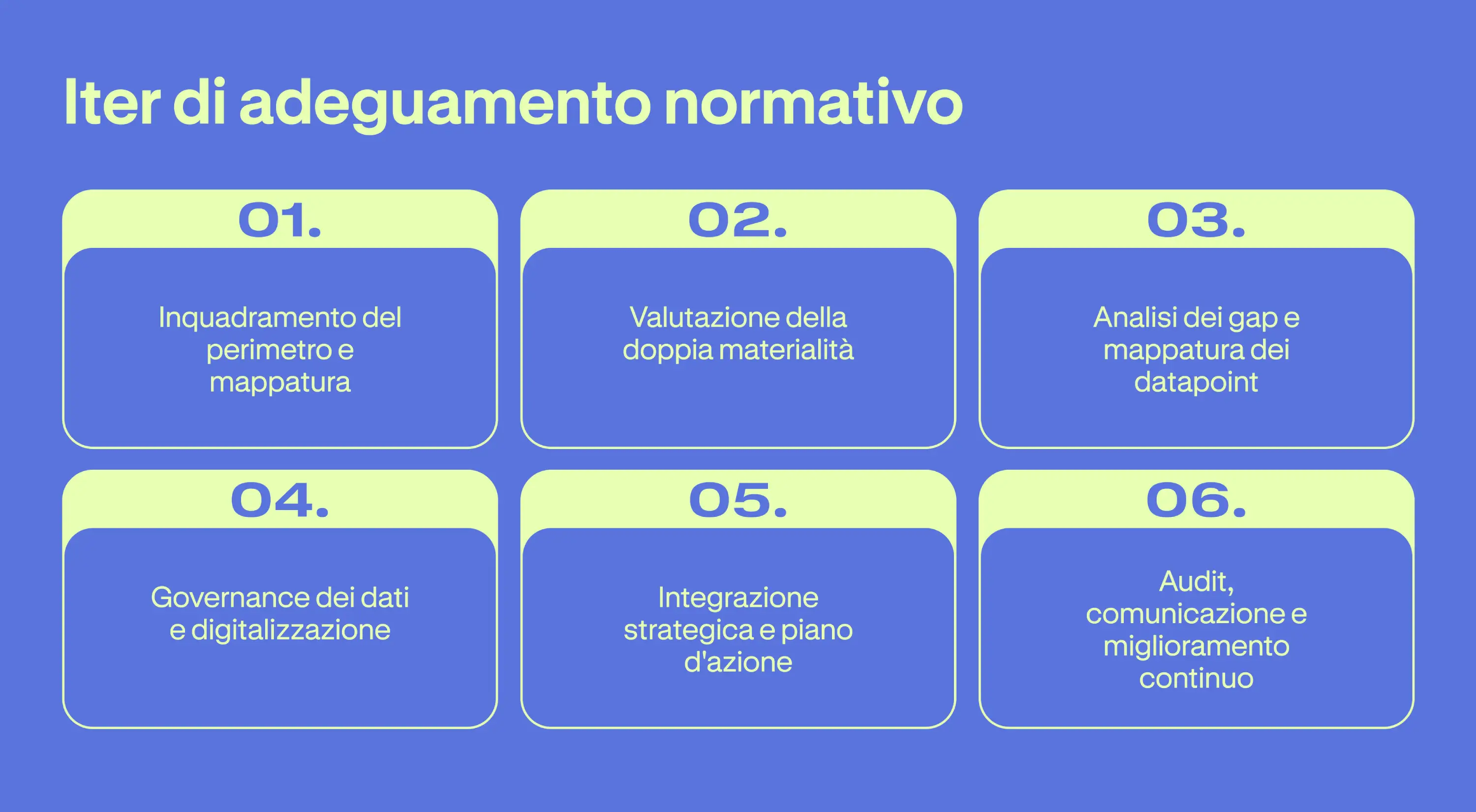
Adapting to the new ESRS standards requires a structured path that goes well beyond simply filling out the final document. If managed methodically, regulatory compliance becomes an opportunity for operational efficiency and corporate strategy.
An effective compliance process is structured into several fundamental phases.
Defining the scope and mapping
The first step is to clearly define the organization's scope, establishing which subsidiaries, facilities, and parts of the value chain must be included in the report, and then identifying the initial impacts, risks, and opportunities related to operations.
Double materiality assessment
We analyze the relevance of ESG issues both externally (the company's impact on ecosystems and communities) and internally (risks and opportunities that affect economic and financial performance). This step, conducted with a management-led approach, prevents the waste of resources on insignificant topics.
Gap analysis and datapoint mapping
Once material topics are established, the disclosures and individual datapoints required by the ESRS are identified. Much of this information is often already present within the company but fragmented across different functions and systems. This phase serves to compare the current state with regulatory requirements, identifying missing data, sources, and process owners.
Data governance and digitalization
Collection flows, calculation methodologies, and internal validation procedures are defined. Adopting software dedicated to sustainability reporting allows for the centralization of metrics, reduces manual management, and tracks the origin of every single data point—an essential element for ensuring calculation uniformity within complex groups.
Strategic integration and action plan
The results of the analysis must directly inform decision-making processes. The corporate strategy is updated by defining clear objectives, operational policies, and action plans, while supporting the organization with internal training to spread the necessary skills across different teams.
Audit, communication, and continuous improvement
Before publication, the report and its supporting documentation can be subjected to verification (assurance or external audit) to certify compliance. This is followed by stakeholder engagement and the establishment of a periodic monitoring cycle, which is useful for comparing results against targets and planning improvements for the following year.
What are the benefits for companies that comply with the new ESRS standards
Beyond regulatory compliance, ESG data structured according to a single European model guarantees concrete benefits that directly impact competitiveness, financial management, and operational efficiency.
The first tangible impact concerns strategic finance. With the recent EBA guidelines, banks no longer evaluate only capital strength, but also the ESG risk management of the companies applying for credit. Having traceable ESRS metrics available simplifies negotiations for access to credit and unlocks subsidized instruments such as Sustainability-Linked Loans, in addition to meeting the growing demand for transparency from investment funds.
At the same time, ESRS solve a historical problem of operational inefficiency by establishing themselves as the benchmark standard for the EU market. Instead of having to chase various voluntary standards or waste energy filling out ever-changing questionnaires requested by banks, clients, and supply chain partners, companies can rely on a single set of data. This uniformity reduces both response times along supply chains and long-term reporting costs.
Finally, compliance protects against greenwashing risks and strengthens the company's reputation. Since ESRS are designed to integrate natively with other European regulations (such as the EU Taxonomy), structuring this information flow today means establishing a single data architecture shared between the Finance department and the Sustainability team, ensuring methodological consistency across all reporting fronts.