


What is the EUFLR Regulation
The European Union has chosen to take decisive action to eradicate the most serious forms of exploitation from its value chains, by introducing Regulation (EU) 2024/3015, known as the EUFLR (European Union Forced Labour Regulation). Starting December 14, 2027, it will be formally prohibited to place on the EU market, make available, or export goods produced using forced labour. The regulation extends its protection to all types of violations, covering practices imposed by private actors, as well as practices imposed by the State: with a rigorous focus on forced child labour. The ban applies without distinction: it concerns both products manufactured within EU borders and imports from third countries.
The urgency of this intervention is clearly highlighted by data from the International Labour Organization (ILO), which estimates that over 27.6 million people are subjected to forced labour worldwide. This violation of fundamental rights tends to be concentrated in the deepest levels of supply chains, where traceability and direct control by companies are often complex.
From a legal perspective, the Regulation adopts the definition established by Article 2 of ILO Convention No. 29, according to which forced labour occurs only in the presence of three specific factors:
- the actual performance of work or provision of a service;
- the absence of a voluntary offer by the person to perform such a task;
- the presence of a threat to the performance of the work that may lead to a penalty, sanction, or retaliation.
Precarious working situations, inadequate wages, or burdensome contractual conditions accepted out of pure economic necessity are certainly problematic from an ethical and social standpoint; although they do not in themselves constitute forced labor, they often represent important red flags and indicators of potential coercive dynamics. For companies, the challenge will therefore be to carefully assess these contexts, verifying whether actual forms of coercion are hidden behind economic fragility.
What the EUFLR Regulation provides
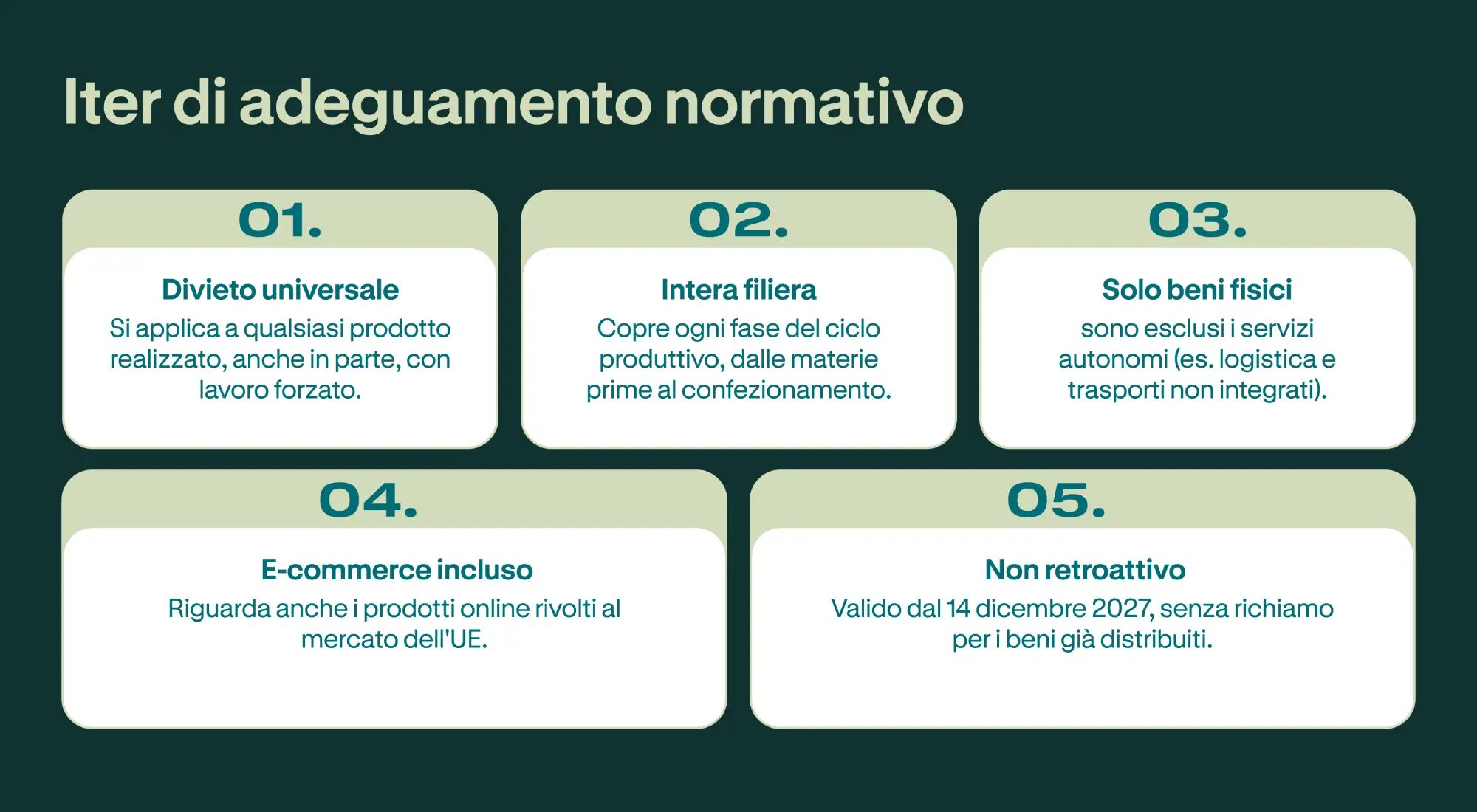
The scope of the measure is broad because it affects goods produced “in whole or in part” through forced labor, with no sectoral exemptions or fast-track lanes. To understand the practical repercussions, the key points are listed below.
- Product sector: the ban extends to any type of product, including military, defense, and high-tech goods.
- Supply chain: any stage of the production cycle is relevant, from the extraction or harvesting of raw materials to intermediate processing, assembly, and final packaging, regardless of where and when the abuse occurred. The scope of corporate responsibility therefore extends beyond direct operating sites.
- Physical goods: Standalone intangible services, such as logistics, transport, or storage, are excluded, provided they are not directly integrated into the production of the good.
- Online sales: A product sold through digital channels or foreign platforms is considered available on the EU market when the offer is directed at the European public (an element that can be inferred from the portal's language, payment currency, shipping options, or web domain). Mere passive accessibility of the site from a European IP address is not sufficient to constitute an infringement.
- No retroactivity: the ban applies to all products marketed from December 14, 2027, onwards, even if manufactured before that date. Goods already in the hands of end-users by that date will not be subject to recall or seizure.
The Regulation also adopts a results-oriented approach: what matters in the eyes of the law is the total absence of forced labor in the marketed good. Having formally adopted codes of conduct or internal policies will not constitute an excuse if, in fact, the final product contains components linked to coercive practices.
If an investigation by national authorities or the Commission confirms a violation, the standard consequence involves a ban on exports and anorder to withdraw products already placed or made available on the market that have not yet reached end-users, in addition to theobligation to dispose of or destroy the affected batches at the economic operator's expense. The Regulation also provides for the possibility of replacing the parts of the product found to have been made with forced labor, instead of disposing of the entire good.
How the EUFLR Regulation and the oversight system work
The effectiveness of the EUFLR is based on a system of controls coordinated at the European level and managed on the ground by individual member countries. By December 14, 2025, every EU state had to designate the competent national authorities tasked with monitoring compliance with the ban, working in close cooperation with customs authorities and the European Commission to block suspicious goods.
Although the burden of proving a violation lies with public authorities, the checks follow a strict process with very tight deadlines.
- Preliminary assessment phase: in the presence of well-founded evidence, the authority may request clarifications and documentation from the economic operator, typically granting 30 working days to respond.
- Formal investigation: if doubts are not resolved, the actual investigation is launched, with response times for the company usually set between 30 and 60 working days.
In this procedural framework, the issue of evidentiary riskemerges strongly. The dispersion of data across purchases, foreign suppliers, and legal departments makes defense particularly complex: if evidence and information regarding the supply chain are not retrieved and presented in a timely manner, clarifying one's position and avoiding sanctions becomes almost impossible.
Even though the Regulation does not prescribe a uniform model or introduce new formal due diligence obligations beyond those already provided for by EU legislation, having a robust due diligence system serves as an important safeguard for companies. The Commission's Guidelines encourage integrating the analysis of forced labor risks into existing compliance models, focusing on key operational priorities:
- precisely map activities and the various levels of the supply chain, focusing audits on high-risk sectors and geographical areas;
- adopt a risk-based approach, prioritizing the most severe potential impacts on the workforce;
- define clear responsibilities within corporate governance, communicating binding requirements to suppliers and business partners;
- prioritize prevention and agree on immediate corrective action plans if irregularities are found;
- periodically monitor the effectiveness of the measures adopted, updating procedures based on audit results;
- transparently communicate to external parties and stakeholders how risks are identified, managed, and mitigated;
- establish accessible, confidential, and secure reporting and grievance channels, including for subcontractor personnel.
Preparing a centralized, constantly updated documentation tool is therefore the fundamental requirement for managing the complexity of the value chain and responding promptly to requests from regulatory bodies.
How to align with the new Regulation
With the entry into force of the EUFLR, the perspective for the production sector changes radically: combating forced labor becomes a strict requirement for accessing the EU market. Failing to be prepared means exposing oneself to the measures provided for by the Regulation, with immediate operational and economic repercussions.
On June 30, 2026 the European Commission made available a comprehensive package of tools and application guidelines, accompanied by the launch of the Forced Labour Single Portal, the digital platform designed as a single point of contact and consultation for businesses, supervisory authorities, and civil society. The final version was then published in the Official Journal on September 3, 2026, fully confirming the content already released in June, without making any changes.
For companies, the priority is to use the available time to strengthen internal controls, starting with these very tools. Turning this preparatory period into a careful review of processes allows you to reach the deadline without critical issues and to enter the market with a more transparent and competitive value chain.