


What is UNI/PdR 192:2026
Published on April 14, 2026 by UNI (Italian Organization for Standardization) at the proposal of the Department for Family Policies of the Presidency of the Council of Ministers, UNI/PdR 192:2026 is the reference practice that defines the requirements for implementing a management system dedicated to work-life balance. The document was created to provide companies with a structured framework to support parenthood, employee well-being, and the management of caregiving responsibilities, by integrating these aspects into standard governance and human resources management activities.
Unlike isolated, ad-hoc welfare initiatives, this practice proposes a work model organized around measurable objectives, continuous improvement processes, and both qualitative and quantitative key performance indicators (KPIs).
As a model applicable to any organization, whether public or private and of any size, the practice aligns consistently with other standards already widely used for social sustainability, such as UNI/PdR 125 on gender equality, Family Audit, the Code for companies in support of maternity, ISO 26000, and ISO 30415.
What are the key points of UNI/PdR 192:2026
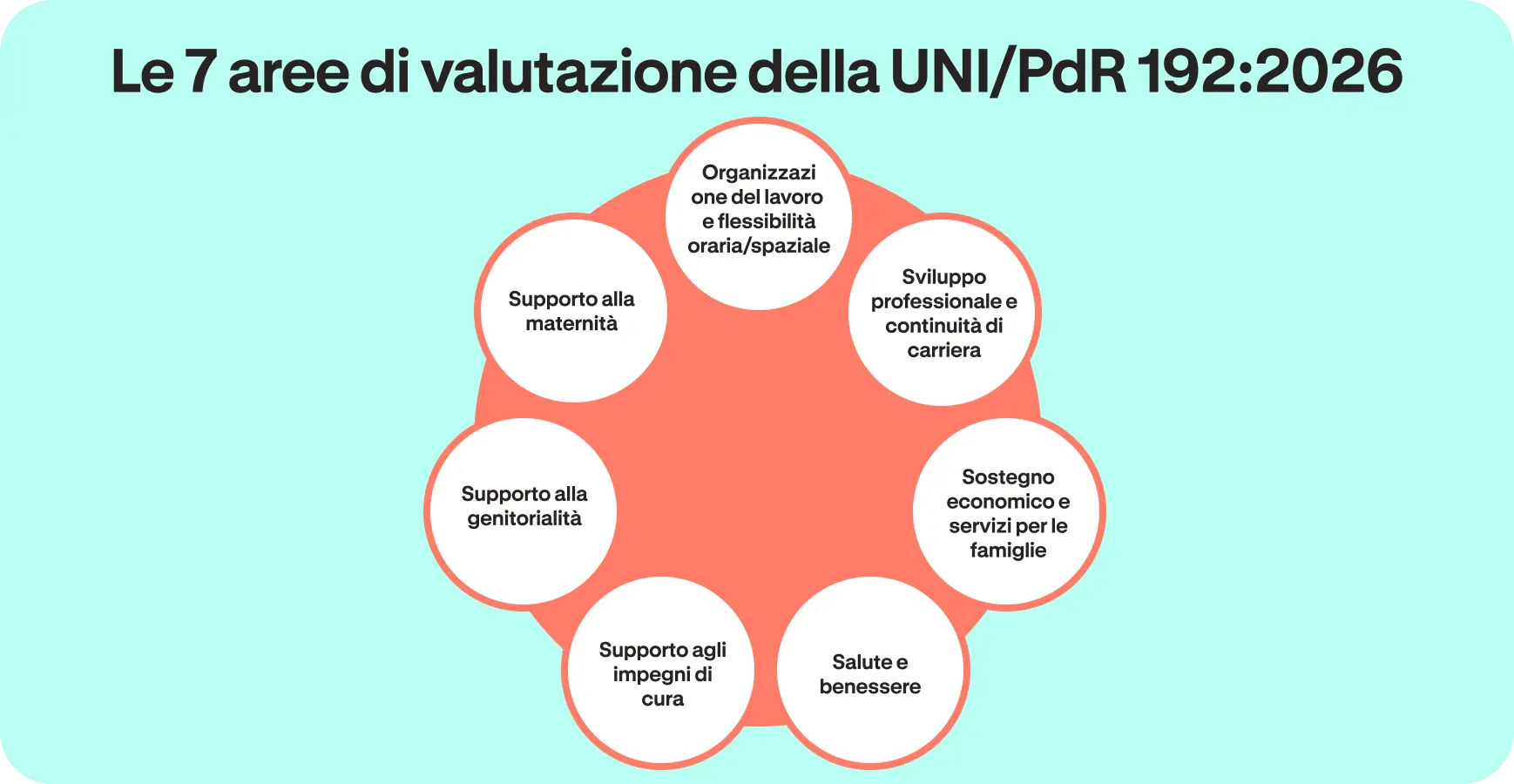
The core element of UNI/PdR 192:2026 lies in its ability to translate the concept of organizational well-being into actionable and measurable interventions. To achieve this goal, the practice is developed around seven assessment areas, within which each organization is required to calculate and monitor specific KPIs both qualitative and quantitative.
- Work organization and flexibility: time and location solutions to facilitate work-life balance.
- Maternity support: protections dedicated to health, leave management, and returning to work.
- Parental support: interventions aimed at both parents to encourage the sharing of caregiving responsibilities.
- Caregiving support: measures for those who must assist elderly, ill, or dependent family members.
- Health and well-being: initiatives aimed at promoting the physical and mental health of individuals.
- Financial support and family services: corporate welfare packages, contributions, or support services dedicated to families.
- Professional development and career continuity: paths aimed at ensuring equal growth opportunities, preventing family needs from hindering career progression.
These indicators are assessed through a periodic review that allows the company to accurately measure its internal maturity level.
One of the most significant aspects of the practice is its application flexibility. The certification is, in fact, adaptable to any type of structure, from private companies to public bodies, as well as third-sector organizations and cooperatives, regardless of their industry or size. The assessment of KPIs therefore follows a principle of proportionality based on the organizational profile and complexity. To this end, the practice divides entities into four main tiers, defining for each both a minimum overall score threshold and a mandatory minimum number of quantitative KPIs to be met in order to obtain certification:
- Tier 1 (Micro): 1 to 9 employees, with a minimum score of 50% and at least 1 quantitative KPI met.
- Tier 2 (Small): 10 to 49 employees, with a minimum score of 50% and at least 1 quantitative KPI met.
- Tier 3 (Medium): 50 to 249 employees, with a minimum score of 60% and at least 2 quantitative KPIs met.
- Tier 4 (Large): 250 employees or more, with a minimum score of 60% and at least 2 quantitative KPIs met.
This modular approach ensures that even the smallest organizations can pursue the certification process without having to take on disproportionate bureaucratic structures, while maintaining the centrality of employee well-being, equal opportunities, and work-life balance within their organizational model.
What are the benefits of the practice
Adopting UNI/PdR 192 offers organizations tangible benefits ranging from human resources management to operational efficiency, as well as significant economic incentives. Structuring work-life balance policies within a verifiable management system allows for the transformation of often fragmented initiatives into a strategic lever for business growth.
The main advantages of obtaining the certification operate on several levels.
- Economic and tax incentives: the Labor Decree (Law Decree no. 62 of April 30, 2026) introduces a relief on INPS social security contributions of up to 1% for certified companies, within a maximum limit of 50,000 euros per year per company. With the signing of the relevant implementing decree, the operational rules have been defined: the certification is valid for 36 months, must be issued by an accredited body for the specific scheme, and the application for the relief must be submitted to INPS exclusively electronically.
- Flexibility and career continuity: the introduction of solutions such as agile working or flexible hours facilitates the return to work after leave, protecting professional continuity and the growth of mothers, fathers, and caregivers.
- Personnel management and attractiveness: improving the internal climate helps increase staff satisfaction and engagement, while reducing phenomena such as turnover, absenteeism, and burnout, with a positive impact on the company's ability to attract new talent.
- Governance and synergy with other standards: the presence of clear KPIs facilitates constant monitoring of results and creates immediate integration with UNI/PdR 125 on gender equality and with ESG standards for social sustainability.
In addition to direct economic savings, the certification therefore allows you to increase the company's reputational value with the financial community, business partners, and staff, demonstrating with objective data a concrete commitment to supporting birth rates and organizational well-being.