

The world of work is undergoing a profound transformation, wherefairness And the social responsibility they are no longer just ethical values, but fundamental pillars of corporate governance. In this scenario, one of the most urgent and discussed topics is that of equal pay.
Despite years of declarations of intent, in Italy the pay gap between men and women remains an open challenge: all too often, with equal roles, responsibilities and hours, differences in treatment persist that reflect a structural nature of the problem. It is precisely to undermine these dynamics that Europe has accelerated its pace with EU Directive 2023/970.
The transposition of this legislation, which already received the first green light from the Council of Ministers on February 5, marks a turning point. These are not just new bureaucratic obligations, but a real one paradigm shift: the introduction of wage transparency mechanisms and concrete protections to ensure that every worker receives a fair compensation for work of equal value.
But what does the implementing decree actually provide? What will the new obligations be for employers and how will they impact on companies' sustainability strategy?
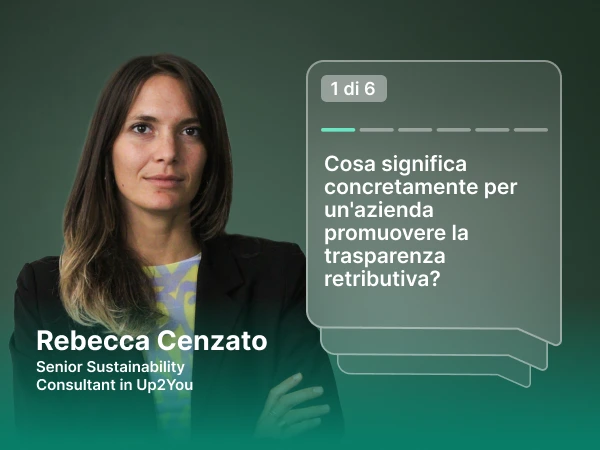
To clarify these points and understand how to transform this obligation into an opportunity for growth and inclusion, we interviewed Rebecca Cenzato, Senior Sustainability Consultant at Up2You.

Rebecca, let's start with the basics. We often hear about 'Pay Transparency', but what does it actually mean for a company and why has this topic returned strongly to the center of the debate just now?
Pay transparency is not only an ethical issue, but a set of precise practices and rules. It means making clear, accessible and shareable the criteria with which a company decides how much to pay its employees and collaborators. This includes, for example, the obligation to indicate the RAL already in job advertisements.
The reason why we are talking about it today is linked to EU Directive 2023/970.
Although the principle of equal pay has been enshrined in European treaties since 1957, the gender gap continues to exist throughout the Union. This Directive was created precisely to transform that principle into reality, activating application mechanisms to no longer leave room for interpretation or ambiguity.
Speaking of numbers, Italian data seem to confirm that there is still a long way to go. What is the current picture of the Gender Pay Gap in our country?
The ISTAT and INPS data are quite clear and unfortunately confirm that the problem is structural in nature. In Italy, the wage gap can reach up to 20 percentage points, with significant peaks in some sectors: we exceed 30% in financial and insurance activities and 23% in commerce.
The most important critical element is that these differences are found on equal terms: same contract, same hours and same responsibilities. It is proof that culturally there is still a lot of work to do; in addition, the current regulations are not enough and a more decisive regulatory push is therefore necessary, such as the one that will come with the decree implementing the Directive.
Let's get to the heart of the legislation. Who will be the people involved and what will change for the workers? Will it really be possible to know the colleague's salary?
Let's start from the perimeter: the new rules will apply to all employers with subordinate contracts (fixed term, indefinite, part-time), including managers. For now, apprenticeships and domestic work are excluded (even these exclusions are indicative of a culture that has yet to evolve in Italy).
Regarding the visibility of the salaries of colleagues and colleagues, a clarification must be made: the right to know the individual salary of an individual person has not been regulated. Transparency concerns average pay levels, broken down by sex and by categories of workers who do the same job. It will be possible to request this information and the company will have to respond in writing within two months. In addition, companies with more than 50 employees will be required to make public the criteria used to determine career increases and progressions.
What are the most stringent obligations for businesses, especially large ones?
The Directive introduces very clear reporting obligations. Companies with more than 100 employees will need to report their gender pay gap in detail.
Then there is a 'guard threshold': if the pay difference Exceeds 5% and cannot be justified by objective and gender-neutral criteria, the company cannot limit itself to taking note of it, but will have to intervene concretely with a joint evaluation together with employee representatives to fill the gap.
It is inevitable that this will scare businesses a bit. What are the main concerns you have on the business side?
The main concern concerns the risk of an increase in litigation. Many companies fear that the publication of wage averages could trigger a shower of adjustment requests or lawsuits.
At Up2You, however, we believe that transparency should not be seen as a threat, rather as an opportunity for companies to evolve towards a fair model. To mitigate risks, the introduction of preventive reconciliation phases is being discussed, but the real solution remains the construction of a solid compensation structure, based on objective skills and merits.
Speaking of concrete solutions, at Up2You how do you support companies that want to actively promote gender equality, perhaps going beyond the simple legal obligation?
At Up2You, we accompany companies in a real process of cultural transformation. One of the main tools we use is support for obtaining certification UNI/PdR 125:2022.
This is the national reference practice for gender equality. It does not consist only of a 'stamp', but it implies that companies are willing to carry out a journey, which touches on a series of fundamental points:
- equal pay between men and women;
- equal access to training and career opportunities;
- attention to work-life balance and parenting policies;
- building an inclusive and safe work environment.
In addition to the ethical value and attractiveness for talent, which remain the heart of UNI/PdR 125:2022, this certification also offers other advantages, such as relief on social security contributions.
At Up2You, we help companies interested in integrating these principles into a framework of social sustainability, exploiting the lever of transparency to stimulate innovation and the development of corporate culture. This is also a way in which we realize sustainability, transforming it from a regulatory obligation to a real competitive advantage.
The new EU Directive on pay transparency is not a simple regulatory update, but an invitation to rethinking corporate culture.
As we saw with Rebecca, the move towards greater wage equity does not only respond to a legal obligation, but to the need to build more inclusive, equitable and resilient organizations, able to attract and retain the best talent.
Although the regulatory transposition of the European directive is still in progress, the complexity of the new requirements, from the reporting of wage gaps to the revision of the promotion criteria, requires companies to planning.
Moving early doesn't just mean avoiding potential litigation, but turning compliance into a strategic asset to improve positioning ESG of the company and mitigate ESG risks, which are increasingly relevant in the eyes of investors and stakeholders.