


What is Extended Producer Responsibility?
La Extended Producer Responsibility (EPR, Extended Producer Responsibility) is one of the most relevant principles for guiding the economy towards real models sustainable and circular.
At the base of this concept lies a fundamental change: the producer's responsibility extends beyond design, the creation and sale of a product, embracing theentire life cycle, including the management of the post-consumer phase, when the product becomes potential waste.
In practice, EPR pushes companies to rethink their processes with a wider vision, which also includes:
- The efficient resource management used to produce goods and packaging;
- The design of collection systems, recovery and recycling that minimize the production of waste.
It is therefore not a simple regulatory requirement, but a real strategic lever: companies that adopt extended producer responsibility models can innovating its products, increase transparency and strengthen its commitment to ESG objectives.
In a competitive environment where environmental regulations evolve rapidly and consumers require more responsible products, EPR represents an opportunity to:
- foresaw regulatory requirements, rather than suffering them;
- Differentiate yourself on the market thanks to products designed to last longer, to be reused or recycled more easily.
The EPR therefore proves to be a fundamental part of the transition to acircular economy, capable not only of reducing environmental impact, but also of generating a competitive advantage in the long run.
The 3 Key Effects of Extended Producer Responsibility
Extended Producer Responsibility produces some very concrete effects on the way in which companies design, manage and value their products throughout the entire life cycle.
In particular, this principle introduces three key changes. Let's see what they are.
Shifting of responsibilities for waste management
With the EPR, the economic and operational burden linked to waste management no longer falls exclusively on local administrations, but is transferred, at least in part, directly to producers. It is therefore the companies that have to bear the costs and the organization of the collection, recovery and treatment systems at the end of their life.
Rethinking the product in a circular key
To be truly sustainable, products must not only perform well in use, but they must also be easy to repair, update, disassemble and recycle.
This leads companies to redesign goods and packaging with a clear objective: to reduce waste and simplify all the phases following the sale. In particular, interventions should focus on:
- repair and maintenance, so as to extend the useful life of the product
- recycling and end-of-life management, facilitating the recovery of materials
In this way, circularity is no longer a “retrospective adjustment”, but becomes an element integrated from the beginning in the product design.
Overcoming planned obsolescence
By connecting more closely the value of use, product life and economic return, the EPR makes it increasingly less convenient to focus on the logic of planned obsolescence. Instead, it becomes more advantageous to extend the life cycle of products and build service-based business models ('servitization'), where the continuous relationship with the customer and the ability to keep the product in use generate new value over time.
How the EPR fits into the regulatory framework of sustainability
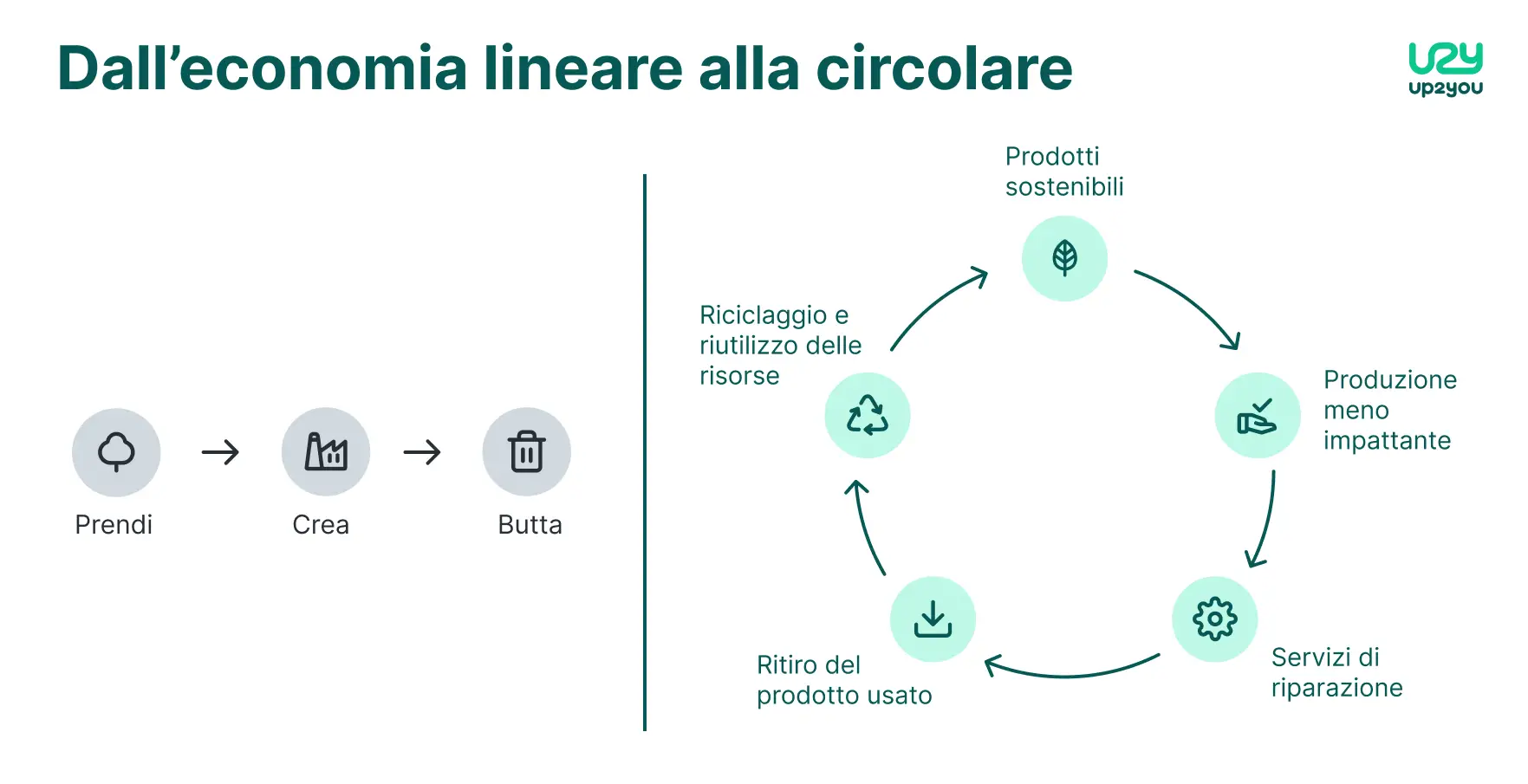
Extended Producer Responsibility (EPR) should not be read as an isolated obligation, but as part of a bigger picture which concerns waste management, recycling, reuse and, in general, the way in which products are designed, used and treated at the end of their life.
In this context, tools such as Life Cycle Assessment (LCA) are essential for evaluating the environmental impact throughout the entire life cycle and for orienting producers' choices towards more sustainable solutions.
In practice, the EPR is part of a ecosystem of rules, standards and practices which touch on different areas: from electronic waste to batteries, from vehicles to consumer goods, to packaging and the overall management of urban and industrial waste.
Each sector presents specific responsibilities and expectations towards producers, who are called upon to rethink products, processes and supply chains in a circular key, integrating measurement (LCA), waste prevention and resource enhancement.
The 5 impacts of the EPR regulation on manufacturing companies
Extended Producer Responsibility (EPR) gives companies a responsibility that covers theentire product lifecycle: from design to production, up to the recovery, recycling and disposal phases. This approach pushes companies to consider the environmental impacts of their decisions from the outset, transforming product design and management into strategic sustainability tools. Let's see in detail what they are.
1. Rethink and redesign products in a circular key
The EPR requires us to rethink the design of products from a circular perspective. Companies must integrate into the design phase elements that facilitate repair, maintenance, disassembly and recycling, exercising control over all phases of the life cycle and also designing for the end of life.
2. Choosing more sustainable materials and optimized packaging
EPR pushes companies to select more sustainable, recycled or recyclable materials, reducing unnecessary packaging. The use of materials that are easier to recover and treat reduces environmental impact and facilitates recycling, essential for the company's circular economy strategy.
3. Design more effective maintenance processes
EPR promotes more durable products, affecting maintenance design. Companies are encouraged to develop processes that ensure optimal performance over time. Scheduled and preventive maintenance, reducing costs and machine downtime, extends the useful life of the product and reduces waste.
4. End of life planning: recovery, regeneration and recycling
EPR has a significant impact on end-of-life management of products, forcing companies to design systems for recovery, potential regeneration and disassembly aimed at separating and valuing materials. This involves, for example, collection procedures, refurbishment and structures to reintroduce recycled resources into the production cycle.
5. Develop and support a recycling chain
Finally, the EPR also involves the need to economically and operationally support the entities that manage recovery and recycling activities. This may mean financing collective management systems, collaborating with specialized operators or developing new business models based on the regeneration and reuse of recovered materials.
The 7 main players in the EPR supply chain
Fulfilling Extended Producer Responsibility (EPR) is often complex for many companies, especially distribution and marketing companies, that do not have the necessary skills and resources internally. To comply, they rely on specialized partners who manage the recovery, regeneration and recycling phases.
The market offers different categories of essential players in supporting companies in the implementation of the EPR, attributable to at least seven main types.
Certification and Conformity Assessment Bodies.
They are accredited bodies that verify the compliance of products and business processes with the regulatory requirements of the EPR. Depending on their competence and authorization, they can issue certifications, certificates and marks that guarantee the correct application of the rules, thus providing companies with an authoritative reference in the field of compliance.
Environmental Consulting Firm.
They support manufacturers in the analysis of EPR regulations, in the assessment of organizational impacts and in the definition of the strategies necessary to fulfill the expected requirements. They also offer assistance in the preparation of operating procedures, in the drafting of mandatory documentation and in the management of the business processes involved.
Consortia and Collective Systems.
Created directly by manufacturers, these bodies jointly manage the responsibilities related to the recovery, recycling and disposal of end-of-life products. An emblematic example in Italy is CONAI, which coordinates the national system for the collection and recycling of packaging, promoting economies of scale and simplifying the fulfillment of obligations for member companies.
Design and Engineering Firms.
They collaborate with companies to integrate the principles of EPR already in the product design phases. Through technical and engineering skills, they support the creation of products that are natively more recyclable, more easily disassembled and with a lower environmental impact, contributing to the transition to circular production models.
Recycling and Disposal Companies.
They come into play when products reach the end of their useful life. They specialize in the recovery, recycling and sustainable disposal of materials, playing a crucial role in ensuring that products are treated in compliance with environmental standards.
Logistics and Transportation Operators.
For a product to be recovered and recycled, the work of those who are responsible for its collection, handling and storage is essential. These activities require specific skills, often managed by dedicated logistics companies or by specialized divisions within existing operators.
Waste Management Software Providers.
Finally, traceability is a key element of EPR. Companies that develop software solutions for waste management offer data collection, data analysis and reporting tools that allow them to monitor flows, document all phases of the process and ensure the transparency required by regulations.