

The panorama of the corporate sustainability It is experiencing a phase of profound acceleration. In a context where European regulations and stakeholder requests are becoming increasingly stringent, international standards must evolve to remain reliable compasses.
In this scenario, the ISO 14001, for years the global pillar for environmental management, is about to experience one of its most significant updates, with the publication of new version scheduled for April 2026. This is not a simple bureaucratic restyling: the transition to ISO 14001:2026 marks a paradigm shift, shifting attention from pure regulatory compliance to real strategic leadership.
Companies are no longer called only to 'limit damage', but to demonstrate climate resilience, protection of biodiversity and a transparent management along the entire value chain. For already certified companies, as well as for those that intend to undertake this path, being found unprepared is not an option.
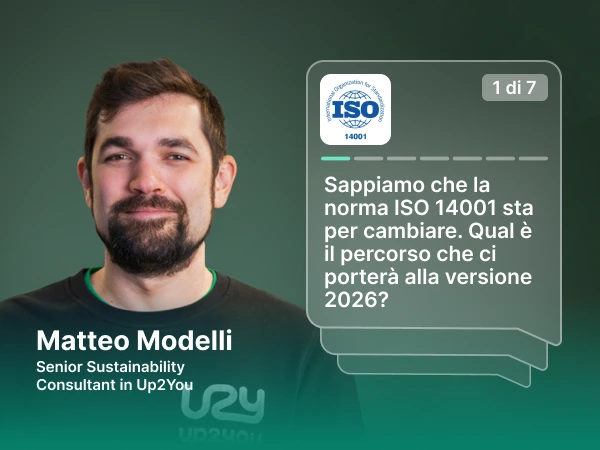
To understand in detail what will actually change in business processes and how to transform these new obligations into opportunities for growth, we have explored the topic with Matteo Modelli, Senior Sustainability Consultant by Up2You.

Matteo, let's start from the basics. For those who don't know it yet, what exactly is ISO 14001 and why is it so central to a company?
ISO 14001 is the international standard that defines how to build an effective Environmental Management System (EMS). It must be imagined as a compass that helps companies identify, monitor and reduce their environmental impacts in a structured way. It is based on the PDCA (Plan-Do-Check-Act) cycle, which is a continuous improvement process that aims to manage risks, optimize efficiency and demonstrate transparency towards stakeholders.
We know that the norm is about to change. What is the path that will take us to version 2026?
We are in a crucial phase. The review process is ongoing and the release of the Final Draft International Standard (FDIS) represents the last step before the official publication, scheduled for spring 2026. This draft is essential because it provides companies with the definitive 'map' of the changes, allowing them not to be caught unprepared at the time of the official release.
What are the main changes introduced by ISO 14001:2026?
In addition to the use of more precise terminology, ISO 14001:2026 will push companies to concretely integrate the environmental management system and sustainability issues into their business strategy, requiring them to explain and measure how much those activities actually contribute to the company's global environmental objectives.
- Climate resilience and biodiversity: the analysis of the business context must include a broader vision, considering not only climate change, but also pollution and the protection of natural resources.
- Widespread leadership: The involvement of management will no longer be enough only at the level of approval of the environmental policy and the SGA; the standard will require solid and decisive ownership by top management and proactive management of the identified risks.
- Change planning: a specific requirement is introduced to manage changes to the management system, ensuring that every business transformation is evaluated from an environmental perspective.
There is also a lot of talk about 'Life Cycle'. How is this concept enhanced?
It's one of the most impactful changes. The new standard pushes companies to look beyond their physical perimeter. It will be necessary to consider the upstream and downstream impacts (suppliers and product life) that the organization may influence. Operational controls are also extended: we will no longer talk only about 'outsourced processes', but about everything that is supplied externally, including products and services.
The calculation of emissions is a key element. What changes on this front with the new standard?
More than a direct formal obligation, we are talking about an essential practical need. The draft of the update places an unprecedented emphasis on climate resilience and environmental risk management. Although the rule does not formally impose the obligation to calculate the Carbon Footprint, establishes that the organization must necessarily determine if climate change is a relevant issue. As a result, it becomes almost impossible to seriously assess your risks or define credible improvement objectives without an accurate measurement of emissions. For companies, both those already certified and those that aspire to become one, the calculation of the Carbon Footprint therefore becomes the fundamental tool for demonstrating compliance with the new requirements.
Matteo, this link with climate management and environmental risks scares many companies that fear an excessive bureaucratic burden in order to be certified according to the new ISO 14001. At Up2You how are you tackling this challenge?
The real heart of the change in ISO 14001:2026 is precisely the work of evaluating and managing risks and opportunities. This is where the operational impact is greatest. To respond to this need, our approach is to start first of all from a gap analysis. This allows the company to assess the impact of updates at the company's management level of the SGA.
Subsequently, to comply with the new requirements, with Climax, our proprietary technology, we support the company in the quantification of its Carbon Footprint and in the subsequent analysis and assessment of environmental risks. This allows companies to approach the entire process in a targeted and timely manner and to make strategic decisions based on the evidence of solid and reliable data. CliMax is not a simple spreadsheet, but a digital ecosystem that automates the collection and analysis of data.
At Up2You we not only provide the technological tool to reduce time and errors, but we constantly support the company thanks to our expert advisors, helping it to transform risk analysis into a real strategic lever for growth.
How long do companies have to adapt?
The planned transition period is three years. If the publication takes place in April 2026, companies will have until May 2029 to update their SGA and align them with the new standard. However, my advice is to move immediately: integrating these innovations requires time and a strategic vision, especially for the analysis, assessment and management of environmental risks.
As we saw with Matteo, the ISO 14001 update It is not a simple bureaucratic update, but an invitation to rethink sustainability as a pillar of business strategy. The integration of the calculation of Carbon Footprint indicates a clear direction: the accurate data measurement It is now the indispensable prerequisite for every company that wants to remain relevant in the market.
Although the period of three-year transition may appear extensive, the complexity of the new requirements imposes a immediate planning. Moving early does not only mean being ready for regulatory deadlines, but transforming the adjustment into a strategic asset: immediately aligning with the new requirements of the standard allows you to acquire a competitive advantage immediate, positioning itself as reliable leaders in the eyes of investors and stakeholders who are increasingly demanding in terms of transparency.