The cosmetics industry In recent years he has experienced a continuous growth, driven by new consumer trends and product innovation. A booming sector, however, brings with it a environmental and social footprint not negligible: from the use of controversial raw materials to the weight of packaging, to the effects on water, energy and working conditions along the supply chain.
Today, more attentive consumers, new European rules and competitive pressures are accelerating a necessary transformation: moving from individual initiatives of some companies to a systemic, measurable and transparent approach to sustainability.
What you'll find in this article:
- the real environmental and social impact of the beauty sector;
- the trends that are redesigning the sector;
- the strategic levers to integrate sustainability throughout the supply chain;
- the most relevant certifications and ratings for cosmetics.
What are the impacts of the cosmetics industry?
According to the report Make Up the Future by Quantis, the contribution of the beauty sector to global greenhouse gas emissions is between 0.5% and 1.5%. The distribution along the supply chain along the entire supply chain is as follows:
- 40% during the use phase of the product (especially water and energy consumption);
- 20% in packaging;
- 10% in raw materials;
- 10% in transport;
- the rest in production and distribution.
To intervene effectively, we therefore need more shared data and metrics: what you measure, you can improve.
A central role is played by packings. Every year, more than 120 billion units of cosmetic packaging are produced, responsible for about 70% of waste in the sector. However, only a small part of these come Recycled: 14% are recycled and just 9% actually become a new raw material, even if these percentages depend a lot on the country.
La plastic It is also among the major causes of marine pollution: it takes up to 500 years to degrade and can fragment into microplastics, which spread in aquatic ecosystems. Oltre 600 marine species are already threatened by waste and microplastics, with impacts also on human health along the food chain.
However, the impacts do not stop at waste. Some commonly used ingredients in cosmetic products, such as palm oil, are linked to agricultural practices that cause deforestation and loss of natural habitats. Others, such as chemical filters contained in some sunscreens, have toxic effects on corals, contributing to the deterioration of coral reefs.
To these are added ethical and social dimensions often less visible:
- child labor in the mica supply chain, a mineral used to give shine to cosmetics;
- inequity in waste management, which affects vulnerable communities (such as large landfills in Latin America);
- animal testing still widespread in some non-EU markets.
Emerging trends in the cosmetics sector
La sustainability it is no longer a niche in the beauty world: today it represents a Strategic lever to promote a competitive advantage of businesses and a response to increasingly aware consumers.
According to data from the Bocconi University's Green Economy Observatory in collaboration with Cosmetica Italia, the participation of companies in the surveys has grown significantly, a sign of a growing commitment and interest in measuring impacts.
One of the main changes concerns the choice of feedstocks. Companies are increasing their use of lower-impact solutions:
- 14% recycled or recovered raw materials
- 8% virgin raw materials with sustainability certifications
- 1% biological or biobased raw materials
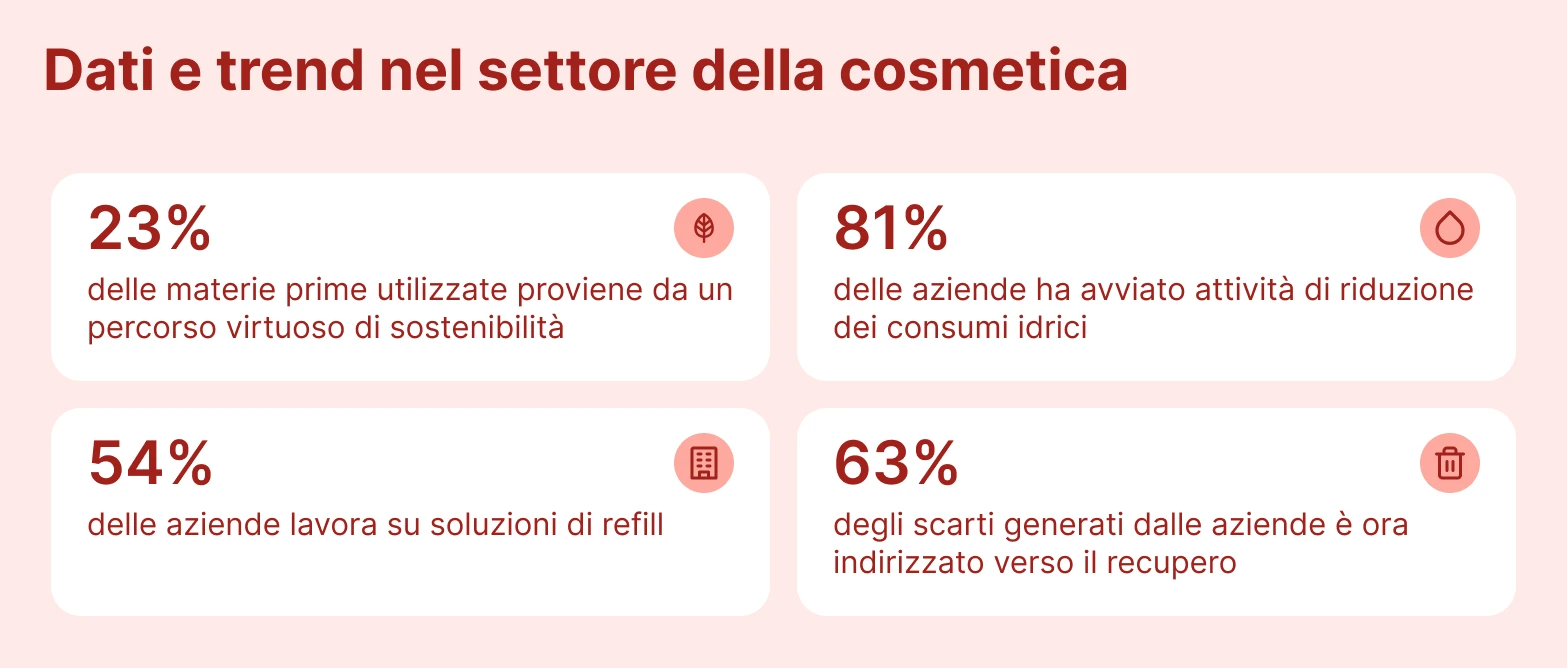
In total, the 23% of the raw materials used can be considered as coming from a virtuous path of sustainability: not yet a dominant share, but already significant enough to show that sustainability is becoming a real and measurable selection criterion.
Packaging is also evolving in a logic of circular economy.
More than half of the companies interviewed, the 54%, said he works on refill solutions, a model that drastically reduces the use of raw materials and directly involves the consumer in more responsible behavior.
In terms of water resources, most beauty companies, 81%, has launched initiatives by saving water in production processes. However, there is still ample room for improvement, in particular on the issue of reuse and the closure of the water cycle.
Progress is also being made in waste management: 63% of the waste generated by companies is now directed to retrieving.
There is also a growing attention to renewables Where approximately one company out of two use clean, purchased or self-produced sources.
However, they remain critical areas to fill:
- 32% some companies do not have a structured plan for managing energy consumption;
- 42% does not have a strategy for reducing climate change emissions.
The sector is also working on social dimension of sustainability.
Initiatives are growing in favor of well-being and safety of people, and many companies invest in social responsibility activities involving schools, cultural and sports associations and non-profit organizations in the area.
The message that shines through is therefore that of a beauty sector where the Change is in progress.
These are no longer just pioneering brands, but a movement extended along the entire supply chain, which is starting to integrate sustainability in a systemic way.
The 7 levers for sustainable development in the cosmetics sector
To evolve towards models that are truly respectful of the environment and people, the cosmetics industry must act simultaneously on several fronts. It's not enough to change an ingredient or introduce a new pack: sustainability requires a systemic transformation, which involves the supply chain from the origin of the raw materials to the disposal of the product.
Let's see what are the 4 light on which the sector must focus.
1. Sustainable ingredients
Having raw materials of natural origin is not in itself a guarantee of sustainability: cultivation, the use of water and soil, the emissions generated, the distances traveled also count.
The difference lies in the certification of the sources, respect for ecosystems and in the ability of the ingredients themselves to biodegrade without leaving harmful residues in the environment. Brands that invest in local supply chains, regenerative agriculture and responsible production processes show how quality, effectiveness and protection of the planet can be combined.
2. Circular packaging
Packaging represents one of the main critical points of the impact of the beauty sector and today requires innovative solutions such as:
- recycled or recyclable materials (glass, aluminum, FSC paper);
- bioplastics of plant origin;
- modular and easy to dispose of packages;
- refill systems that extend the life of containers.
Reducing the amount of materials placed on the market, encouraging recyclability and reuse means drastically cutting waste, especially plastic, and contributing to the development of a truly circular model.
3. Ethical production
Sustainability cannot be separated from those who contribute to the creation of value every day. An ethical production includes:
- fair working conditions;
- safety of production environments;
- respect for rights along the supply chain;
- zero animal testing;
- support for the local communities involved.
Clear and verifiable social policies are now an integral part of the quality of a cosmetic product and an element increasingly considered by consumers.
4. Transparency and traceability
A key pillar is maximum transparency along the supply chain: for a consumer, knowing where a vegetable oil or mineral powder comes from is essential to make an informed choice.
Transparency also means communicating environmental and social data honestly, avoiding confusing messages or generic wording such as' natural 'or 'green'. Trust is built with verifiable, accessible information and with a commitment that is measurable over time.
What are the most important certifications in the cosmetics sector?
Sustainability in the cosmetics sector can no longer be based only on declarations of intent or suggestive claims: to demonstrate a real environmental and social commitment, you need recognized, verifiable and transparent standards. Here are the most significant certifications adopted today in the beauty world, each with a specific focus.
CCPB (Organic and Natural Certification)
It guarantees cosmetics with mainly organic or natural ingredients. Organic certification requires at least 95% organic ingredients, while natural certification requires at least 90% natural raw materials. Petroleum derivatives, formaldehyde, paraffins, GMOs and synthetic fragrances are prohibited. In collaboration with Almagisi Srl, it has also introduced Bioceq for eco-biocompatible detergents.
NATRUE (Natural and Organic Cosmetics Association)
International non-profit association committed to the protection of natural and organic cosmetics. Its categories classify products as natural, natural with at least 70% of biological components or biological with at least 95%. It is applied by recognized certification bodies such as CCPB.
ICEA (Institute for Ethical and Environmental Certification)
Independent consortium active on environmental and ethical standards. He is one of the founders of the internationally recognized COSMOS discipline. COSMOS Organic includes at least 20% of the total organic ingredients and 95% of processed agricultural ingredients; COSMOS Natural certifies natural products that do not reach high organic levels.
AIAB (Bio Eco Cosmetics)
Issued by the Italian Association of Organic Agriculture, it certifies non-allergenic and GMO-free vegetable raw materials, ingredients deriving from organic farming, ecological packaging and the absolute absence of animal testing.
Ecocert
Strict standard that recognizes certification only if at least 95% of the ingredients are natural and 95% of the plant substances are of organic origin. Synthetic ingredients such as silicones, petrolatum, artificial fragrances and dyes, and components tested on animals are excluded.
BioAgriCert
Body that certifies different levels of naturalness and organic based on the percentage of compliant ingredients. It allows companies to also add the VeganCert certification, to guarantee compliance with vegan principles.
EU Ecolabel
Official European trademark awarded to products with a reduced environmental impact throughout their entire life cycle: from the extraction of raw materials to disposal. It guarantees biodegradability, ecotoxicological quality and waste reduction.
Nickel, Chromium and Cobalt Tested
It indicates a specific control over the traces of heavy metals, generally kept below 1 ppm, a threshold that reduces the risk of allergies and skin sensitization.
Ecovadis
An international rating system that evaluates the ESG (environmental, social, governance) performance of a company and its supply chain. It makes it possible to measure in a comparative way the commitment to sustainability and ethical responsibility.
SBTi (Science Based Targets initiative)
Validate the objectives for reducing greenhouse gas emissions by ensuring that they are based on scientific evidence and aligned with the objectives of the Paris Agreement on climate.
CDP (Carbon Disclosure Project)
It evaluates the transparency and climate performance of companies in terms of emissions, use of water resources and protection of forests, through a globally recognized rating system.