Make your company compliant with the CBAM regulation



CBAM key dates

Protect your company from risks and penalties
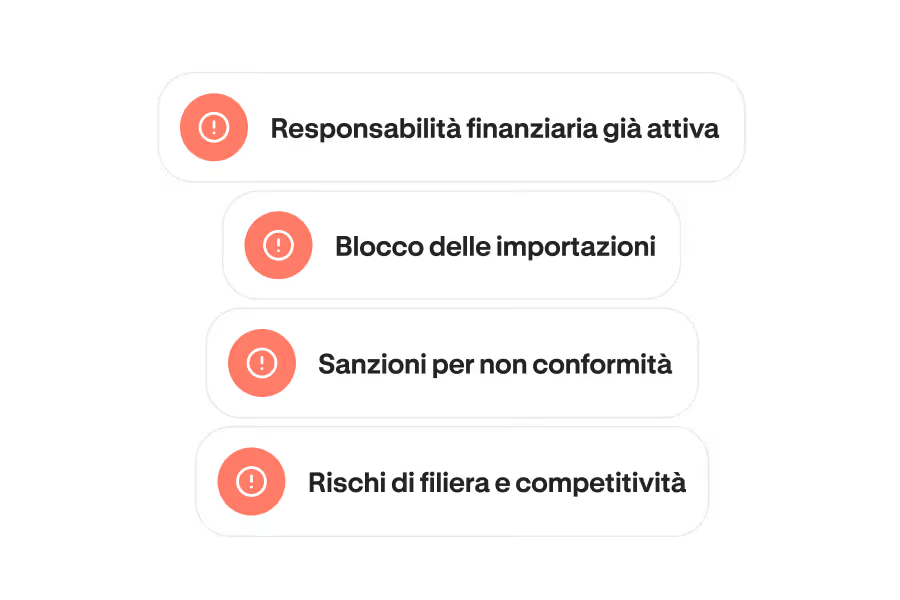
- Financial liability already active: for imports starting January 1, 2026, the cost of emissions must be considered at a commercial and accounting level, even though the purchase of certificates will take place from 2027;
- Import blocks: without authorized CBAM declarant status, it is no longer possible to release subject goods for free circulation;
- Penalties for failure to declare: fines are imposed for failure to submit the CBAM declaration;
- Supply chain risks and competitiveness: European customers require reliable emissions data along the supply chain; suppliers that are not aligned risk losing competitiveness and market share.
Achieve CBAM compliance with Up2You

- Definition of a strategy to assess exposure risk and opportunities, with projections of CBAM costs based on European and global ETS scenarios
- Estimation of the financial burden for each supplier or product category and application of the de minimis threshold (50 t/year)
- Support in obtaining authorized CBAM declarant status, a mandatory requirement to continue importing and avoid customs blocks

- Collection of necessary information (origin, materials, production process, verification certificates) and identification of data to be requested from suppliers
- Design and distribution of structured supplier questionnaires, with dedicated follow-up
- Calculate embedded emissions with Climax, using primary data and the robustness required for third-party verification (mandatory from 2026)

- Assistance with entering data on the official EU platform and surrendering CBAM certificates
- Planning for certificate requirements and managing the annual declaration
- Continuous monitoring of regulatory developments (new sectors, certificate rates, reporting processes)
How to reduce CBAM costs: a concrete example
A concrete example using aluminum
The cost using default values is €175/t, compared to €136/t using the actual carbon footprint, representing a 22% saving: approximately €39,000 on 1,000 tonnes imported.
Get support from a dedicated team of consultants

What is the CBAM Regulation?

The Carbon Border Adjustment Mechanism (CBAM) is an EU policy established by Regulation (EU) 2023/956. It applies a carbon price to imports of certain emission-intensive goods, aligning them with the costs borne by European companies under the ETS system. It was simplified by Regulation (EU) 2025/2083 (the "Omnibus" package), which has been in effect since October 20, 2025.
Who is subject to CBAM?
EU importers of regulated goods: cement, iron and steel, aluminum, fertilizers, electricity, and hydrogen, along with certain precursors to these categories. Importers remaining below the de minimis threshold of 50 net tonnes/year are exempt from all obligations (reporting, authorization, and certificate purchase) — hydrogen and electricity are excluded from the threshold calculation. This exemption covers approximately 90% of importers while still capturing 99% of emissions.
What are the key deadlines?
- Transitional phase (reporting only): October 1, 2023 – December 31, 2025.
- Start of financial obligations: January 1, 2026.
- Application for authorized CBAM declarant status: by March 31, 2026, to continue importing.
- Purchase of CBAM certificates: starting February 2027.
- First annual declaration and certificate purchase: by September 30, 2027, for 2026 imports.
What are the main obligations and risks?
Financial liability for embedded emissions begins with 2026 imports. Without authorized declarant status, it is impossible to import regulated goods. Failure to submit a CBAM declaration also carries penalties, in addition to the challenges of gathering supply chain data and the risk of losing competitiveness.
How can Up2You help me?
We offer a comprehensive path covering every stage: strategic analysis and cost projection based on ETS scenarios, support in obtaining authorized declarant status, data collection and supplier engagement, emissions calculation using Climax (the RINA-validated module of the Up2You Platform), declaration and certificate management on the EU platform, and continuous regulatory monitoring. Analyzing actual data also allows you to reduce CBAM costs by over 20% compared to default values. We combine certified consultants (EcoVadis Training Partners, B Leaders) with proprietary technology to achieve compliance without disrupting your operations.