


How does waste management work
The waste management represents the beating heart of circular economy: it is not limited to the simple removal of waste, but includes the entire architecture for the collection, transport, treatment and disposal of waste generated by every actor in the company.
Today, manage flows correctly it does not only mean deciding 'where to throw' an object, but it implies a strategic vision aimed at Reduce waste production at the source, while ensuring the traceability and enhancement of the material to reinsert it into production cycles. This complex system must respond to increasingly pressing global challenges, which make technological innovation an essential tool for ensuring efficiency and transparency.
The reasons that have pushed waste management to the top of the sustainability agenda are many, let's see the main ones.
- The explosion of volumes: the increase in global consumption and the complexity of modern supply chains generate an unprecedented amount of waste.
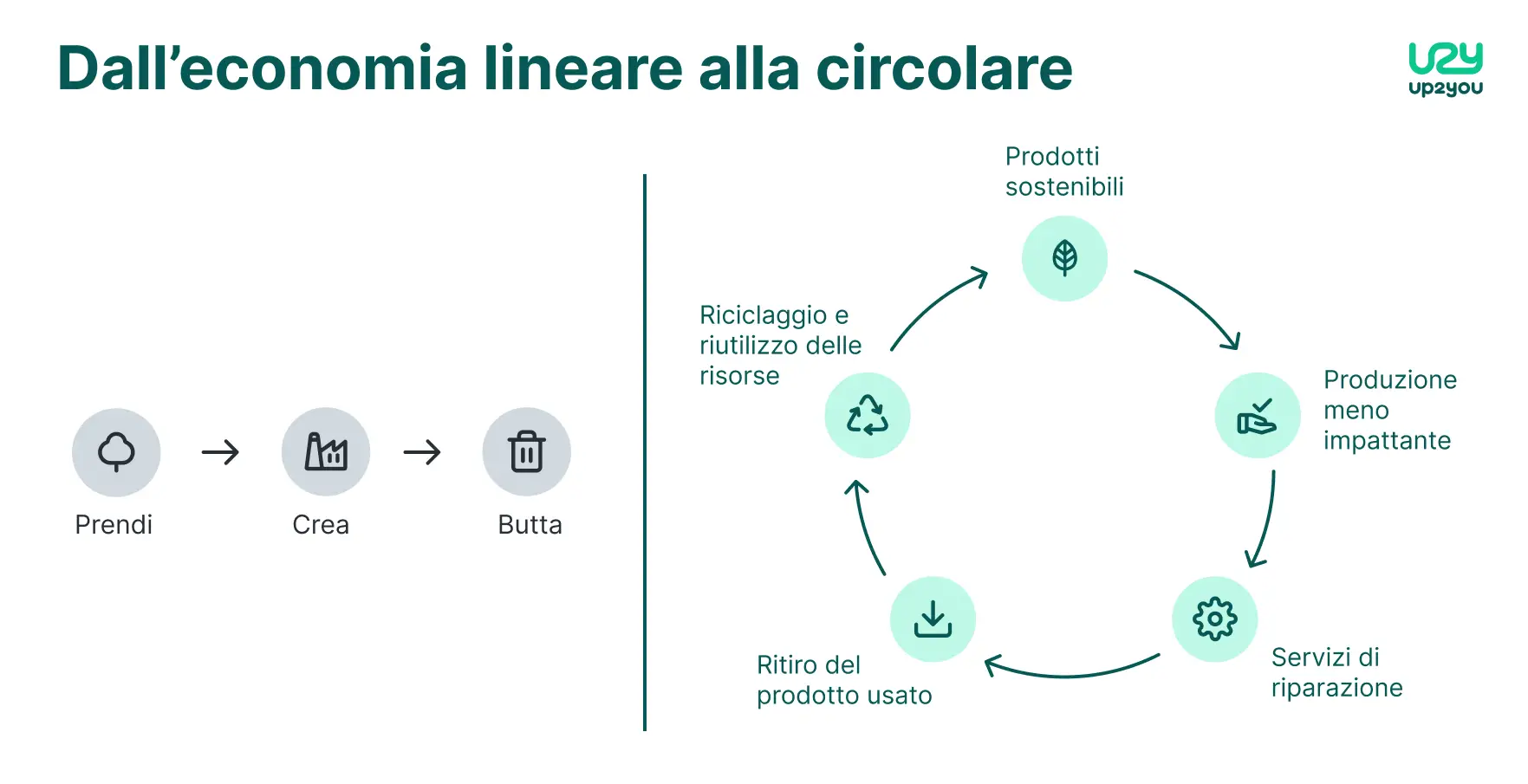
- The transition to circularity: the scarcity of raw materials and the need to reduce climate-altering emissions require the abandonment of the linear “produce-consume-dispose” model.
- Regulatory compliance and social responsibility: the growing regulatory pressure, combined with the demand for transparency from investors and citizens, requires timely reporting of environmental impacts.
To navigate properly in this sector, it is essential Distinguish the different categories of waste, since each flow requires specific recovery paths.
A first major distinction concerns the municipal waste, produced mainly by households and local businesses, which include both differentiated fractions (such as paper, plastic, glass and organic) and undifferentiated waste.
In parallel, we find the special waste, deriving from industrial, artisanal and productive activities. The latter are further divided into Dangerous and Not dangerous, depending on the presence of harmful substances, and include complex categories such as WEEE (electronic waste), sewage sludge and construction waste.
Ultimately, the real challenge of modern management lies in the ability to classify waste according to its potential: to distinguish what it is recyclable From what can be recovered energetically allows you to maximize the material recovery rate, drastically reducing the Use of landfill and transforming what was an environmental cost into a precious resource for the planet.
How the CSRD transforms waste management into a strategic pillar
If in the past waste management was perceived by companies as a mere logistical cost or a bureaucratic burden to be fulfilled, today the paradigm has radically changed: waste management has become a fundamental pillar of CSRD (Corporate Sustainability Reporting Directive).
With the extension of the non-financial reporting obligation to an increasing number of companies, the data relating to the production and recovery of waste are no longer simple numbers in a loading and unloading register, but critical indicators of business resilience. Report according to the ESRS standard means to demonstrate concretely how the company mitigates its environmental impacts and how it manages resources along the entire value chain.
This evolution transforms waste management from a cost center to reputation leverage and access to capital, but it brings with it an unprecedented regulatory urgency. We are no longer in the field of voluntary ethical choice, but in that of stringent compliance dictated by Packaging Regulations (PPWR).
Entered into force onFebruary 11, 2025, this regulation imposes on companies a real 'expiration date': the August 12, 2026. By this watershed date, organizations must be ready to apply the new operating regulations, a countdown that requires a immediate review of packaging and end-of-life management processes.
In this scenario, integrating the waste strategy into sustainability reporting is not only a formal act, but a necessity to manage three critical fronts.
- Granular data traceability: the only way to meet the CSRD audit requirements and the new PPWR restrictions is to have reliable, digitized and verifiable data on every kg of waste produced.
- The reduction of the carbon footprint: optimizing material recovery makes it possible to reduce Scope 3 emissions, directly improving the company's sustainability profile in official reports.
- Mitigating governance risks: opaque waste management exposes the company to high legal and reputational risks (such as accusations of greenwashing), negatively affecting the ESG rating and the relationship with financial stakeholders.
This transition marks the definitive transition to a waste management model oriented to valorization of every single material used. Being ready for the 2026 appointment means implementing monitoring systems today capable of transforming regulatory compliance into a competitive advantage lasting.
How to monitor the supply chain through the Digital Product Passport (DPP)
If regulatory compliance and reporting according to the CSRD represent the strategic framework, the adoption of a circular economy model constitutes its operating engine, capable of transforming the complexity of the supply chain into a transparent and controlled ecosystem.
In this context, the tool destined to revolutionize the relationship between production and end of life is the Digital Product Passport (DPP). We can imagine the DPP as a real one 'digital identity card' which accompanies each product along the entire supply chain, collecting and storing crucial data on its origin, composition and method of disposal. It is not just a repository of information, but a technological enabler that allows companies to have a total visibility on what happens upstream and downstream of their production processes.
Implementing a system based on a digital passport means moving from passive flow management to a active supply chain monitoring, where every material is traced and every supplier is called upon to meet verifiable sustainability standards.
The integration of the DPP into business dynamics unlocks immediate competitive advantages for the circular economy, finally making feasible processes that were previously fragmented or uncertain.
- Precision in recovery and recycling: by providing reliable data on the chemical and material composition of the components, the DPP eliminates ambiguities in the waste selection phase, ensuring that every waste is directed to the correct treatment plant.
- Life cycle extension: immediate access to repair manuals and technical diagrams facilitates reuse and regeneration, reducing the need to enter new raw materials into the system and drastically reducing waste production.
- Real-time supply chain auditing: The digital passport acts like a magnifying glass on suppliers, allowing them to verify that the materials purchased comply with the promised environmental requirements and facilitating the collection of data necessary for regulatory compliance.
This level of traceability radically transforms the way in which a company interacts with its network of partners and, last but not least, with the final market. In fact, the DPP enables an increasingly aware and informed consumer, which through a simple scan can Access the product story in real time, verifying its environmental impact and instructions for a correct end of life.
In a market where the value of an asset is now linked to its documented sustainability, the digital passport becomes the technological bridge necessary to combine the transparency required by the CSRD with the operational efficiency imposed by new global challenges.
How the Scope 3 reduction in emissions transforms waste into traceable resources
The circular management of waste represents the practical translation of the most ambitious climate objectives, acting as one of the most effective levers for Shoot it down Scope 3. In a context in which companies are called to answer for indirect emissions along the entire value chain, recycling and reuse cease to be simple virtuous practices and become data-based decarbonization strategies.
Every time a material is returned to the production cycle, in fact, the activation of new extraction, refining and transport processes is avoided, drastically reducing the carbon footprint associated with the supply of virgin raw materials. It is a step that shifts the focus of waste management to energy and climate efficiency, where value is generated by the ability to keep resources in circulation at their maximum utility.
This evolution is made possible by a fundamental paradigm shift: thanks to advanced monitoring and traceability systems, waste ceases to be a disposal cost and becomes a trackable resource. This process of ennobling rejection makes it possible to act on three critical fronts.
- Conversion into an economic asset: digitalization certifies the quality and purity of the recovered material, transforming it into an asset that can be sold on the market or reusable internally with the same guarantees as traditional raw materials.
- Optimization of energy consumption: material recovery is inherently more efficient than primary production; remelting aluminum or regenerating plastic polymers requires a fraction of the energy needed for extraction processes, with an immediate benefit on competitiveness and global sustainability.
- Validation of environmental performance: having a traceable waste provides objective evidence for climate reporting, allowing you to declare real and measurable reductions in emissions to your stakeholders, protecting the company from the risks of greenwashing.
Ultimately, looking at waste through the lens of the circular economy means converting an operating liability into a'business opportunity documented. Companies that will be able to govern this transition, using data to validate their recovery processes, will not only be more resilient in the face of resource volatility, but They will lead the market defining new standards of transparency and environmental responsibility.