

With the entry into force on April 7, 2026 of Regulation (EU) 2026/667, the European Union formalizes an intermediate objective that defines the course of the coming decades: to achieve a net reduction in greenhouse gas (GHG) emissions by 90% by 2040, taking as a reference the 1990 levels (a goal that combines a domestic target of 85% with a maximum contribution of 5% deriving from high-quality international credits).
This new piece of legislation represents both a technical update of the Green Deal, but also the regulatory framework within which the European economy and industry will operate in the coming decades. For businesses, understanding the scope of this standard is crucial for Anticipate market changes and ensure its future competitiveness.
In this article, we will explore the details of the Regulation, the value of its binding nature and the tools provided to support the productive fabric in this unprecedented transformation. Let's start.
What does the new Regulation (EU) 2026/667 provide
The European Union's path to climate neutrality marks a new fundamental stage with the official adoption, which took place ofMarch 11, 2026, of Regulation (EU) 2026/667. This legislation complements the European climate law (EU Regulation 2021/1119) by inserting an extremely ambitious intermediate goal: net reduction in emissions of 90% by 2040 compared to 1990 levels.
It is interesting to note that this 90% target is not a monolithic block, but the result of a strategic combination of efforts. In fact, the legislation provides for:
- one 85% domestic goal, based on the direct reduction of emissions produced within the borders of the Union;
- one additional contribution of up to 5% deriving from the use of high-quality international credits, thus ensuring flexibility without compromising the environmental integrity of the project.
The choice of this target responds to a precise strategy based on different pillars.
- Scientific basis: the text follows the guidelines of the European Scientific Advisory Board on Climate Change, ensuring that political objectives are aligned with the real physical needs of the planet.
- Impact assessment: The European Commission has confirmed, through detailed analyses, that this path is necessary to maintain European economic competitiveness in an increasingly decarbonized global market.
- Management of natural wells: The Regulation places an unprecedented emphasis on the need to protect and strengthen carbon sinks, such as forests and soils, balancing the reduction of emissions with the natural capacity to sequester CO2.
The goal is to provide a clear and binding trajectory that allows companies to plan your long-term investments, transforming the climate challenge into an active and strategic management of ecosystems and resources.
What does 'legally binding' mean
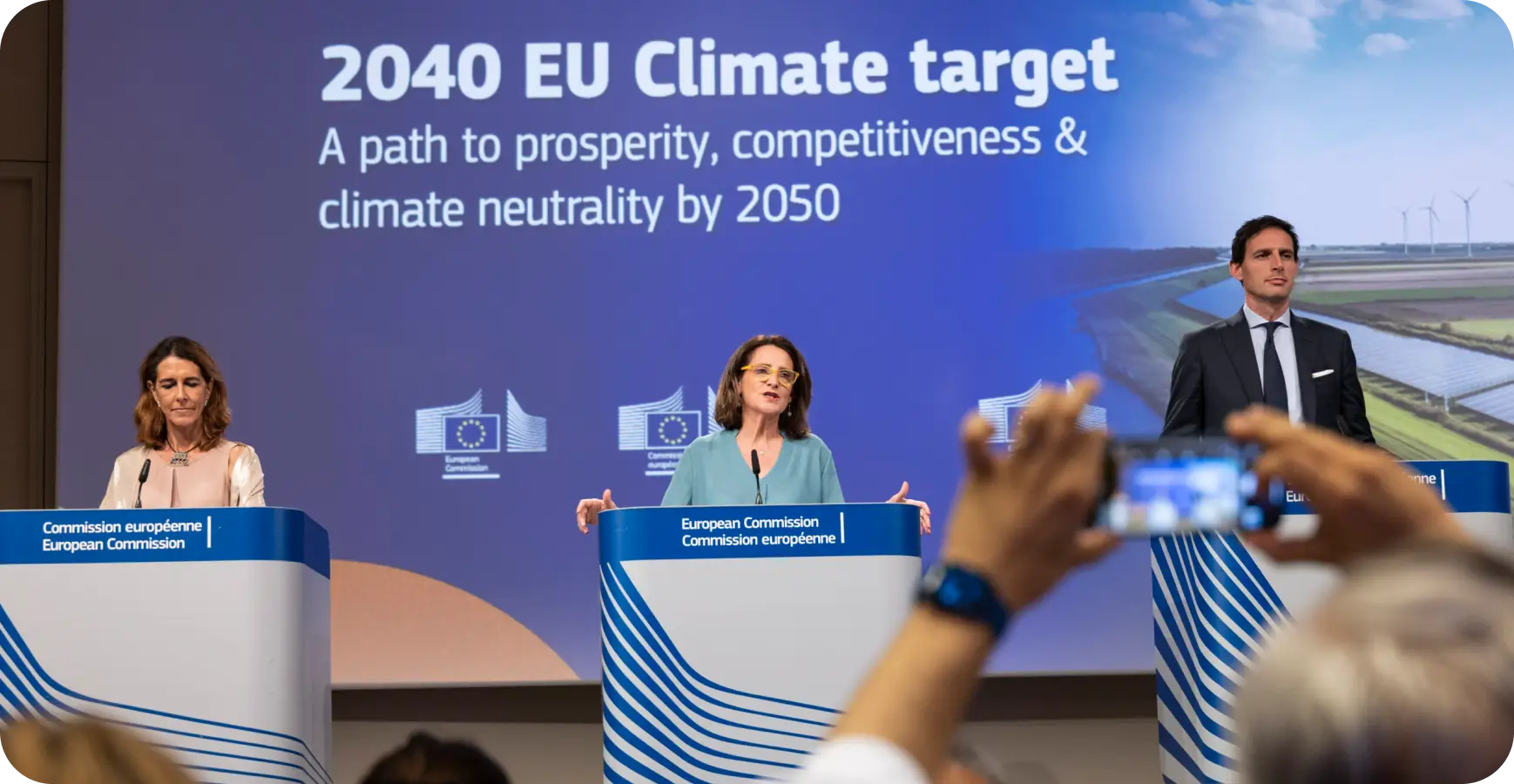
Unlike a simple declaration of intent or a non-binding political agreement, Regulation (EU) 2026/667 represents a legal obligation for all intents and purposes, binding in its entirety and directly applicable in each of the Member States. This nature of 'immediate law' radically transforms the regulatory landscape, since every member state is now required to update their national climate plans so that they are fully consistent with the new -90% target.
This Regulation therefore represents a legal requirement that, if disregarded, exposes countries to real risk of infringement procedures and heavy economic sanctions by the European Commission.
The legislation also introduces the fundamental principle offairness in burden sharing, establishing that any delays or deficiencies in the reduction of emissions in a given economic sector cannot be compensated by burdening excessively on other sectors. This guarantees protection to stability of the entire production system, while offering businesses unprecedented legal certainty.
For corporate decision makers, the regulatory nature of the text provides a stable and predictable regulatory framework, essential for orienting business strategies and long-term investments towards low-emission models.
It is therefore clear that the entry into force of this legislative framework establishes that the energy transition is a strictly regulated path, which requires coordination between institutions and the private sector.
ETS2, credits and protections: EU tools for industrial competitiveness
To support this ambitious path while protecting the economic fabric, Regulation (EU) 2026/667 introduces operational measures and flexibility mechanisms designed to make the transition sustainable also from a financial point of view. The objective is to Decarbonizing without deindustrializing, providing companies with the time and tools necessary to adapt.
Here are the main strategic levers provided for by the legislation.
Postponement of ETS2
To ensure a smoother and less traumatic transition for operating costs, the operation of the new emissions trading system for the construction and road transport sectors (the so-called ETS2) has been officially postponed. The departure has been moved to 2028, offering an additional year of breathing space to adapt infrastructures and logistics models.
International Credits and Permanent Absorbments
In the period 2036-2040, the use of high-quality international credits will be allowed to offset up to 5% of 1990 emissions. However, the Regulation is categorical: environmental integrity and respect for human rights must be guaranteed as a matter of priority in the selection of such credits. At the same time, the role of permanent absorptions such as BIOCCS (capture and storage of carbon from biomass) and DACCS (direct capture from air) is being promoted, essential for managing the most difficult to reduce residual emissions (the so-called hard-to-abate).
Safeguarding industrial competitiveness
The legislator has placed a strong emphasis on the protection of SMEs and energy-intensive industries, with the aim of avoiding the risk of “carbon leakage” (the relocation of emissions to countries with less stringent regulations). Through initiatives such as the Clean Industrial Deal, the EU is committed to facilitating access to finance and ensuring a level playing field at a global level, supporting the technological renewal of the productive sector.
These mechanisms show that the -90% goal is not seen as a punitive limit, but as a They fly for innovation, supported by a regulatory framework that seeks to balance climate rigor and economic resilience.
What are the impacts and consequences for businesses of the new Regulation (EU) 2026/667
If, on the one hand, the -90% target does not immediately impose an obligation to cut drastically for the individual company, on the other hand, it acts as a guide that It will guide all the complex legislation in the field ESG for the next few years.
For the business fabric, this means that the main impact will not come from a single isolated constraint, but fromcoordinated evolution of existing regulations, which will see a progressive tightening on decarbonization expectations to ensure consistency with the 2040 objective.
Specifically, companies will need to monitor carefully three fundamental areaswho will be influenced by this new trajectory.
ESG reporting
Expectations on the reporting of transition plans and on due diligence activities along the supply chain will become significantly stricter. Companies will be called upon to present climate objectives closely aligned with the European target, demonstrating with reliable data how they intend to contribute to the 90% reduction.
EU taxonomy
The technical screening criteria used to define an economic activity as “environmentally sustainable” will be updated. It is expected that the emission thresholds for obtaining subsidized financing or for attracting 'green' investments will gradually tighten, making climate compliance an increasingly central requirement for access to capital.
Evolution of the EU ETS system
As confirmed by the text of the Regulation, the trajectory of the Emissions Trading System (EU ETS) will be drastically revised to align with the new targets. The goal is to allow only an extremely limited amount of residual emissions after 2039. In this context, although it is not yet an obligation enshrined in this regulatory text, the European legislator has already begun to evaluate an acceleration of the gradual elimination of free fees starting from 2028. This direction, while still being the subject of technical discussion, signals the clear intention to push heavy industries towards faster technological innovation than expected.
For companies, Regulation (EU) 2026/667 therefore represents an unambiguous signal: sustainability is no longer an accessory element of reporting, but the parameter on which resilience and resilience will be measured Business Competitiveness in the medium and long term.