

What is the PPWR regulation
The Packaging and Packaging Waste Regulation (PPWR) represents a milestone in the European Union's environmental strategy and a real “regulatory reset” for the entire packaging sector.
Published in the Official Gazette on January 22, 2025, this regulation was created with the ambitious objective of building a fully circular packaging system, drastically reducing the environmental impact and the waste of natural resources.
Unlike the previous Directive 94/62/EC, the choice of 'Regulation' as a legal instrument marks a fundamental change of pace: the PPWR is immediately binding in all 27 Member States without the need for national transposition. This uniformity eliminates the risk of legislative fragmentation between different countries, ensuring aharmonization rules that apply indistinctly both to companies based in the EU and to anyone who imports packaging into the single market.
The regulation intervenes systemically on Every phase of the product life cycle, introducing extended obligations involving producers, distributors and consumers. In summary, the PPWR establishes precise provisions for the following activities.
- Design and materials: stringent requirements to improve recyclability and increase the use of recycled content in packaging.
- Reduction and reuse: binding objectives for the reduction of waste and the promotion of efficient reuse systems.
- Safety: gradual elimination of dangerous or harmful substances within packaging materials.
- End of life management: new rules on labeling and collection systems to optimize the recycling of every material placed on the market.
The introduction of the PPWR obliges all players in the supply chain to reconsider your operational strategies. Although it remains to be verified how much this regulatory framework will be able to streamline the current complexity of circular economy European, it is certain that companies today are faced with a transformative challenge that can no longer be postponed, necessary to ensure compliance and competitiveness in an increasingly sustainable market.
The 3 main objectives of the PPWR regulation
The PPWR is not only a technical standard, but a fundamental pillar of European Green Deal and the EU's environmental policy agenda. Its ultimate purpose is to decouple economic growth from the use of resources, in line with the commitments made by the Union within the framework ofParis Agreement for the fight against climate change.
To achieve this goal, the regulation defines a strategy based on three main guidelines, aimed at radically transforming the way in which we conceive packaging.
1. Reduction and minimization of waste
The first objective is to act at the source, drastically reducing the overall volume of packaging placed on the market. This means pushing companies towards an essential design that eliminates the superfluous (the so-called “over-packaging”) and uses materials that reduce the overall environmental footprint.
2. Promotion of reuse
The regulation intends to undermine the “disposable” model by encouraging the adoption of reusable packaging. Through specific targets and rules on reuse, the goal is to extend the useful life of products, transforming them from waste to circular resources within closed logistics circuits.
3. Increase in recycled packaging
The PPWR aims to increase both the quality and quantity of recycling. To do this, it introduces the principle of Design4Recycling, which imposes standardized recyclability requirements and sets minimum quotas of mandatory recycled content in new packaging, thus fueling a solid and efficient market for secondary raw materials
In addition to these pillars, the regulation aims at a greater transparency and harmonization. Thanks to standardized labeling requirements and targeted bans on certain types of critical packaging, the EU aims to create a single market where rules are clear to all stakeholders. In this perspective, waste management is no longer just a matter of protecting the territory, but a strategic lever to promote a sustainable and competitive evolution of the entire European production system.
Who is the PPWR regulation aimed at
The PPWR regulation has an extremely wide scope and is not limited to only manufacturers of boxes or bottles. On the contrary, it defines precise responsibilities for a plurality of obligated subjects, involving the whole value chain. If your company enters, distributes or manages packaging in the European single market, it is very likely that it will be called upon to respond to these new standards.
Specifically, the regulation is aimed at the following categories of subjects.
- Packaging manufacturers: all companies that physically manufacture the packaging, which must ensure that the products comply with the new design and recyclability criteria (Design4Recycling).
- Importers: anyone who introduces packaging or products already packaged from non-EU countries. These subjects are responsible for verifying that what is imported complies with strict European regulations, avoiding penalties upon entering the market.
- Distributors and suppliers: the logistics players along the supply chain who distribute packaging, ensuring traceability and compliance with labeling regulations.
- End users and packaging companies: It is perhaps the largest group, which includes all the companies that use packaging to contain, protect or present their products. We are talking about key sectors such as food, cosmetics, pharmaceuticals and e-commerce, where packaging is an integral part of the sales experience.
- Waste managers: public and private entities involved in the collection, selection and recycling, who will have to adapt their processes to meet the new material recovery targets.
What does the PPWR regulation provide
The PPWR does not just provide guidelines, but imposes a tight schedule with binding legal objectives. The macroscopic goal is to reduce packaging waste per capita of 5% by 2030, of 10% by 2035 And of the 15% by 2040 (compared to 2018 levels).
To achieve these goals, the regulation intervenes on several fronts:
1. Mandatory recyclability and “Design4Recycling”
Dal January 1, 2030, all packaging placed on the market must meet strict design requirements for recyclability. Compliance will not be based on a generic self-certification, but on a performance classification system divided into three classes (A, B, C).
The regulation provides for a progressive restriction of market access based on these classes:
- From 2030: the placing on the market of packaging with a recyclability rate of less than 70% will be prohibited. This means that only products belonging to classes A, B and C can be marketed.
- Since 2038: the requirements will become even more stringent. The ban will also extend to Class C (i.e. packaging with recyclability between 70% and 80%). Consequently, starting from this date, only Class A and B packaging will be allowed, with a recyclability rate equal to or greater than 80%.
2. Minimum recycled material content (PCR)
To encourage the closure of production cycles, the PPWR introduces the obligation to integrate a minimum share of post-consumer recycled plastic (PCR) in the new packaging.
Starting from January 1, 2030, the minimum recycled content targets for plastic will vary in a range between 10% and 35%, depending on the type of polymer and the intended use:
- 30% for disposable beverage bottles and for contact-sensitive PET packaging (e.g. food industry).
- 10% for contact-sensitive plastic packaging made from materials other than PET.
- 35% for all other types of plastic packaging that do not fall into the previous categories.
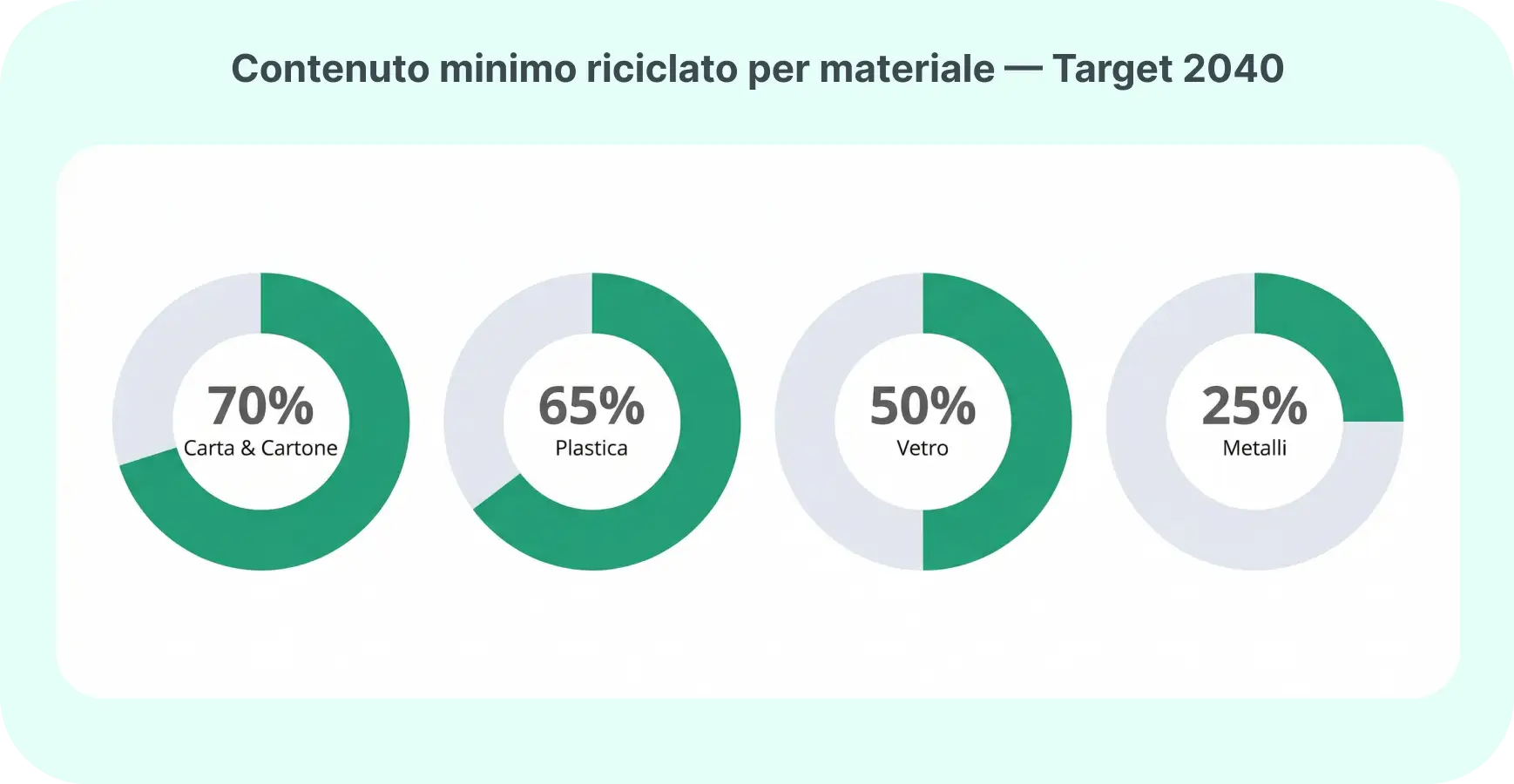
Evolution of the targets at 2040: Mandatory thresholds will increase significantly by 2040, reaching benchmarks up to 65% for most categories. Ambitious recycled content targets are also set for other key materials, with minimum targets set at 50% for glass, 70% for paper and cardboard and 25% for metals.
3. Goodbye to disposable use and promotion of reuse
The regulation declares war on visible waste by banning, from 2030, some types of single-use plastic considered superfluous.
- Fruit and vegetables: Stop packaging for fresh fruits and vegetables under 1.5 kg.
- Horeca: Prohibit single-dose bags (sauces, sugar) and single-use packaging for food and drinks consumed in bars and restaurants.
- Hotellerie: Say goodbye to miniature bottles of shampoo and lotions. At the same time, the mandatory percentages of reusable or refillable packaging for large appliances, takeaway drinks and e-commerce shipping.
4. Minimization of packaging and management of empty space
The regulation introduces strict criteria to limit the excessive use of materials, defining compliance obligations with differentiated deadlines.
- From 12 February 2028: companies responsible for filling sales packaging must ensure that empty space is reduced to the minimum necessary to ensure the functionality and protection of the product. Design solutions aimed exclusively at increasing the perceived volume, such as double walls, raised bottoms or non-functional layers, will be prohibited.
- From 1 January 2030: for the transport and e-commerce sector, a maximum empty space limit of 50% is set compared to the total volume of the assembled packaging.
5. Safety and Dangerous Substances
The PPWR protects consumers' health by placing strict limits on chemicals. There is a ban on placing food packaging on the market that exceeds certain thresholds of PFAS (the 'eternal chemicals'), in addition to strict restrictions on heavy metals such as lead, cadmium, mercury and hexavalent chromium.
6. Harmonized labeling and transparency
To facilitate recycling, from August 12, 2028 Will a system of come into force universal labeling. The packaging will bear harmonized symbols throughout the EU, coordinated with those on the recycling containers. This will finally make it clear to consumers how to properly dispose of each material, drastically reducing erroneous deliveries.
When does the PPWR regulation come into effect
The publication of the regulation (EU) 2025/40 in the Official Gazette of the European Union, which took place on January 22, 2025, has officially kicked off the new regulatory course. Although the text has formally entered into force on February 11, 2025, its practical application will follow a precise schedule to allow companies to adapt.
Here are the key steps to keep in mind.
- August 12, 2026: It is the watershed date. After an 18-month transition period, the regulation will become fully enforceable. From now on, the provisions of the PPWR will be directly applicable in all Member States and the previous Directive 94/62/EC will be largely repealed.
- A phased implementation (2026-2040): It is important to stress that not all obligations will start immediately. The legislator has provided for a 'schedule' of progressive deadlines: the first bans on single-use packaging and the recyclability requirements are set for the 2030, with even more ambitious targets projected towards 2035 And the 2040.
- Technical details in progress: To date, the general regulatory framework has been drawn up, but it is not yet fully operational in the smallest detail. In the coming years, the European Commission will publish several delegated acts which will define crucial technical standards, such as calculation methodologies for recycled content, precise recyclability criteria and auditing standards.
Precisely because of this evolutionary nature, it is essential to maintain a constant regulatory oversight. Not being caught unprepared means monitoring the release of the implementing decrees to integrate the new technical specifications into their production and logistics processes before the final deadlines.
How to prepare for the entry into force of the new PPWR regulation
Although 2030 may seem far away, the PPWR is not a simple regulatory review, but a structural transformation of the packaging system in Europe. For companies, this means that the time to act is now: building closed cycles, testing new materials and converting production lines are processes that take years to be both technically and economically sustainable.
Forward-thinking companies are already turning this obligation into a competitive advantage. Here are the key actions to prepare right away.
1. Packaging analysis and sustainability
The first step is to take a photograph of the existing through a Gap analysis with respect to future PPWR requirements. It is essential to:
- Map the packaging park analyzing the composition of each material used;
- Evaluate recyclability verifying if the current designs are part of the future merit classes (A, B, C) or if they need a restyling with a view to circularity;
- integrate recycled materials developing strategies for the supply of recycled polymers (PCR) or bio-based solutions, anticipating mandatory quotas.
2. Communication and labeling
Transparency will be a pillar of compliance. Businesses need to start:
- Revise environmental labeling verifying the information provided today and prepare for future harmonized marking standards at EU level;
- document sustainability measures Rendering any effort made to facilitate future audits is traceable.
3. Regulatory and strategic supervision
As many technical details will be defined in the coming years through delegated acts, it is essential to:
- Activate constant monitoring to stay updated on legislative developments and to adapt the strategy in real time;
- Aim beyond the legal minimum developing solutions that exceed the basic requirements to position themselves as industry leaders in the eyes of consumers and investors, who are increasingly attentive to environmental impact.
In this complex scenario, collaboration with experts becomes a strategic asset. Taking immediate action means not only ensuring regulatory compliance, but seizing the innovation opportunities that the market of the future already requires.