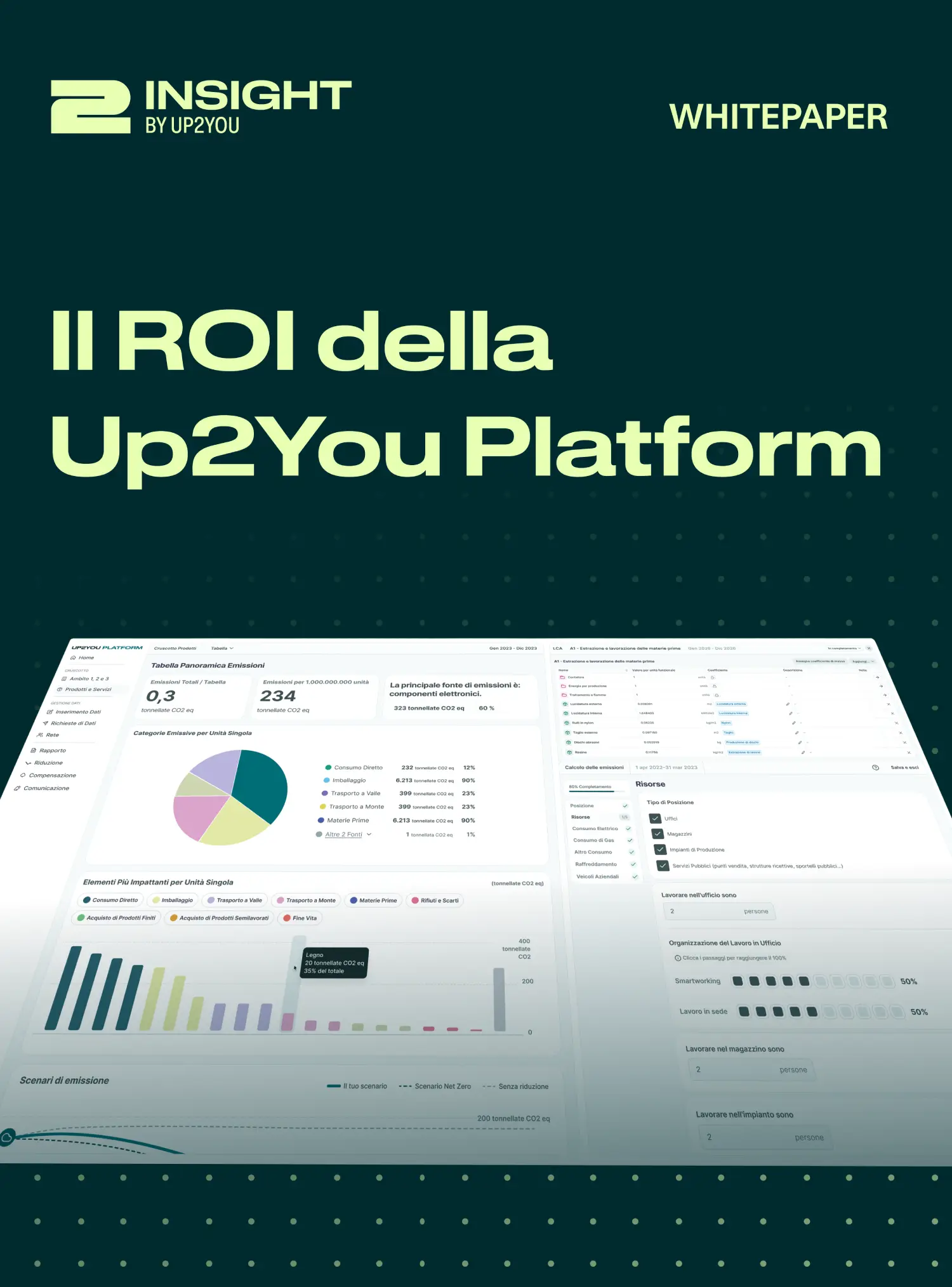
The ROI of the Up2You platform
The limitations of the traditional reporting model
Today, companies face ever-increasing regulatory pressures in sustainability: the advent of new regulations and continuous ESG data requests from the supply chain are forcing a change of pace. Yet, due to outdated tools, sustainability teams find themselves wasting up to 60-70% of their time collecting and reconciling data instead of generating value.
This operating model, based on endless Excel spreadsheets, emails, and shared folders, shows clear structural limitations: it generates enormous inefficiencies and increases the risk of manual errors, as well as creating vulnerability if the person managing the data decides to leave the company. Therefore, continuing to manage ESG complexity with outdated methods is no longer sustainable.
Measuring impact: the value of the Up2You ecosystem
At Up2You, we believe that sustainability must transform from a simple regulatory obligation or sunk cost into a reusable and permanent business asset. For this reason, the Up2You Insight team has produced this white paper in which we analyze the return on investment (ROI) of the Up2You ecosystem, identifying 14 value drivers that the platform generates compared to the traditional reference model. The ROI was then calculated based on three key components.
- Direct monetary savings: such as the drastic reduction in working hours and the elimination of costs for external licenses.
- Avoided costs: mitigating sanction risk, preventing calculation errors, and safeguarding against non-compliance.
- Opportunity value: the ability to respond quickly to client and investor questionnaires, accelerating access to credit.
What you'll find in the free white paper
- The challenges of the traditional model and how workflow automation overcomes them.
- A detailed analysis of 14 value elements that the platform inherently generates, grouped into 4 strategic pillars: operational efficiency, compliance and reliability, scalability, and strategic resilience.
- The practical calculation of estimated cost savings, applied to 3 different company size categories (small, medium, and large).