


What is the EmpCo directive
The European EmpCo directive, an acronym for Empowering Consumers for the Green Transition, is Directive (EU) 2024/825, approved by the European Parliament and the Council of the European Union on February 28, 2024 and entered into force in March of the same year.
Its main objective is to bring order to environmental communication: the regulation protects shoppers from unfair greenwashing practices, promotingtransparent informationthat is measurable and based on verifiable data.
From a legislative standpoint, the EmpCo directive does not create an entirely new or isolated legal regime, but rather intervenes directly in two existing pillars of European law, which are:
- the Unfair Commercial Practices Directive (UCPD), or Directive 2005/29/EC on unfair commercial practices;
- the Consumer Rights Directive, or Directive 2011/83/EU on consumer rights.
With the EmpCo Directive, the EU requires anyone selling in the single market to substantiate their environmental claims with third-party verification on packaging, digital channels, or at points of sale.
This directive is the already operational European component of a broader strategy against sustainability misinformation. The second component, the Green Claims Directive, was intended to define in detail the scientific criteria and verification procedures for substantiating environmental claims, but its progress has stalled: in June 2025, the Commission announced its intention to withdraw the proposal, and the final trilogue was suspended. The withdrawal was never formalized, and the text remains in limbo. For businesses, the message is clear: the binding rules on environmental claims are those of the EmpCo Directive, and they apply from September 27, 2026, regardless of the outcome of the Green Claims Directive.
What the EmpCo Directive entails: the Article 23 "blacklist"
The EmpCo Directive acts to guide shoppers toward more informed choices, ensuring transparency of information and the truthfulness of advertising messages.
From a regulatory perspective, the amendment to the Consumer Code (Art. 23) introduces a definitive "black list" of prohibited commercial practices in all cases. The ban applies to the conduct itself, removing the need to prove that the consumer was actually misled.
The six categories of prohibited practices cover the following areas.
- Uncertified labels: the use of self-produced seals, marks, or labels that are not based on third-party certification systems or established by public authorities is prohibited (for example, using an "Eco-Approved" logo invented by the company).
- Generic claims without recognized excellence: terms such as "green," "eco-friendly," "sustainable," or "environmentally friendly" cannot be used unless the product boasts recognized and demonstrable environmental excellence (such as the EU Ecolabel certification).
- The "whole for the part" fallacy: it is not permitted to extend an environmental benefit that applies only to a single element or component to the entire product or company (such as declaring a product "made of recycled material" when only the packaging is).
- Neutrality through offsetting: it is prohibited to present a product as "carbon neutral" or "zero impact" if that result is achieved solely through the purchase of carbon credits. Offsetting is not equivalent to actual emission reduction.
- Legal requirements presented as distinctive advantages: it is prohibited to promote as a unique sustainability benefit something that is already a regulatory obligation for the entire product category (for example, boasting about the absence of a chemical substance already banned by law).
- Practices regarding obsolescence and durability: it becomes punishable to conceal limitations related to software updates, claim a product is repairable when it is not, or induce consumers to replace a product before necessary (such as signaling a printer cartridge as "empty" when it still contains ink).
When did the EmpCo directive come into force
The adoption of EmpCo follows a schedule defined at the European level and implemented by individual Member States.
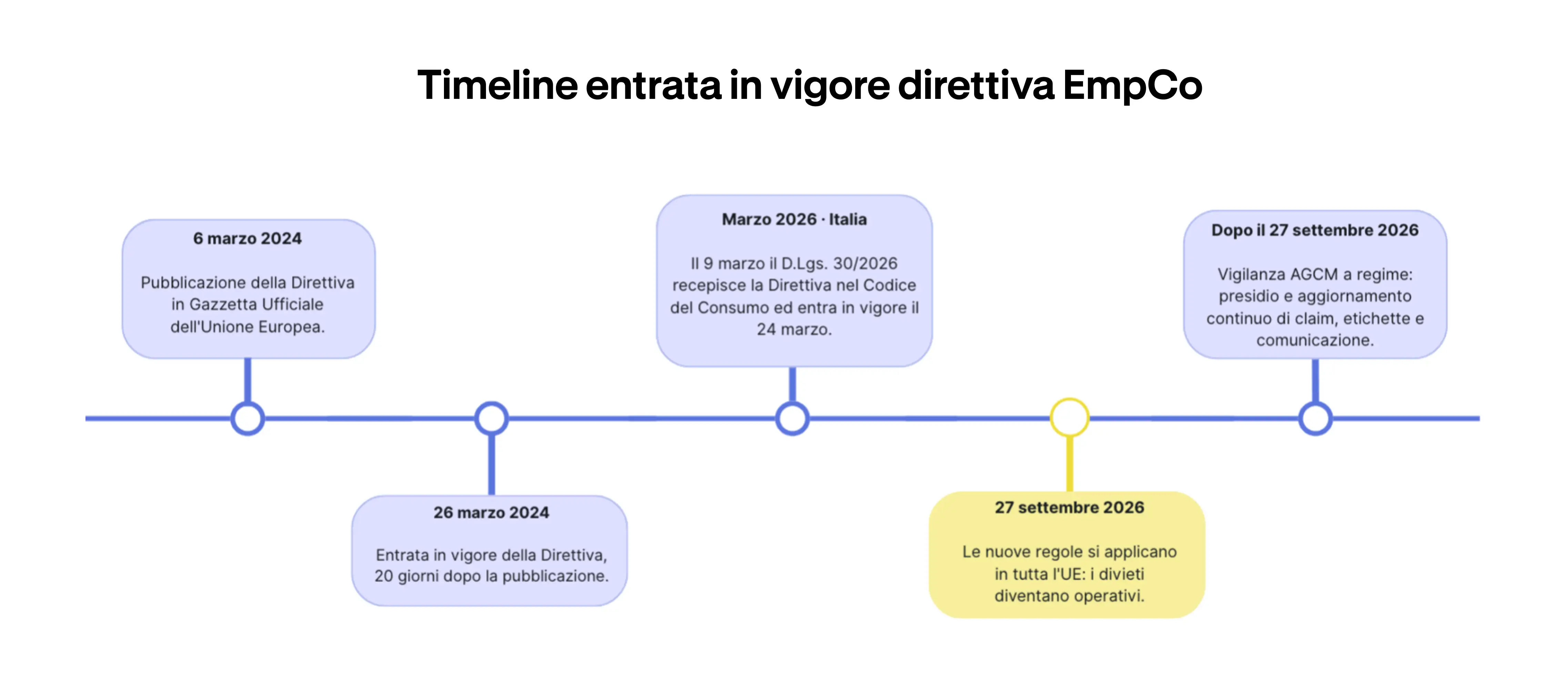
The key milestones of this regulatory timeline include:
- March 6, 2024, official publication of Directive (EU) 2024/825 in the Official Journal of the European Union;
- March 26, 2024, the Directive comes into force at the European level, 20 days after its publication;
- March 2026 (Italy): on March 9, Legislative Decree 30/2026 is approved, incorporating the regulation into the Consumer Code, with an official effective date of March 24;
- September 27, 2026, full and binding application of the new rules across the European Union, with all established prohibitions becoming operational;
- after September 27, 2026, commencement of full-scale oversight by the AGCM (Italian Competition Authority), which will require companies to maintain and continuously update labels, claims, and commercial communications.
Which companies does the EmpCo apply to
The EmpCo directive extends its scope to all Business-to-Consumer (B2C) commercial practices carried out within the European Union market. The regulation applies to both direct manufacturers and those involved in distribution and retail, regardless of whether the company is based inside or outside the EU borders.
The regulation directly affects any business that:
- sells goods or services to end users in any of the 27 Member States;
- makes environmental claims about its products, services, or brand;
- displays sustainability labels, marks, badges, or eco-seals;
- communicates commitments and goals related to environmental performance in its promotional campaigns.
The scope of application significantly impacts high-consumption sectors, such as retail, e-commerce, consumer electronics, textiles, automotive, and durable goods. Regulatory responsibility also covers the entire commercial communication chain: from messages printed on packaging and shelf information to digital product pages and online advertising.
Framed within the European Green Deal and the Circular Economy Action Plan, the directive acts both to combat unfair commercial practices and to expand pre-contractual information obligations. The directive therefore aims to provide buyers with comparable data on durability, repairability, and environmental performance.
What are the risks for those who do not comply with the EmpCo directive?
Compliance with the new regulations is an essential requirement for continuing to communicate and sell within the European Union. Any non-compliant communication is effectively classified as an unfair commercial practice.
Failure to comply exposes businesses to economic, legal, and reputational consequences. Let's look at what these are.
- Allegations of unfair commercial practice: the Italian Competition Authority (AGCM) has the power to order the immediate removal or correction of misleading claims, prohibiting their further use in promotional channels.
- Heavy financial penalties: monetary fines can reach up to 10 million euros or up to 4% of the company's annual turnover .
- Precautionary measures and reputational damage: the AGCM can order the urgent suspension of the commercial practice and the publication of the conviction. Public exposure of the sanctions has a direct impact on brand credibility.
- Suspension of business operations: in more serious cases or in the event of repeated non-compliance with regulations, the authority may order the temporary suspension of business activities.
- Exposure to market reports: the initiation of sanction proceedings can stem not only from official inspections but also from reports submitted by customers, consumer protection associations, and, to a large extent, competing companies.
Managing the verification of your environmental claims in a timely manner allows you to safeguard your business, turning regulatory compliance into a guarantee of transparency and market stability.