

The industrial landscape is changing: the sustainability it is no longer just an ethical choice, but a strategic asset for navigating between stringent regulations and new market demands.
The world of Manufacture is going through a profound transformation, where the circular economy and environmental responsibility have become fundamental pillars of corporate governance. In this scenario, one of the most urgent issues is the adaptation to new European standards, such as the regulation PPWR (Packaging and Packaging Waste Regulation) in the world of packaging.
Despite the technical complexity, for Italian SMEs the challenge is open: too often there is a lack of structured data to respond to the requests of large players and investors.
But what are the real difficulties that the sector must go through? How can companies intervene to respond to increased regulatory requirements?
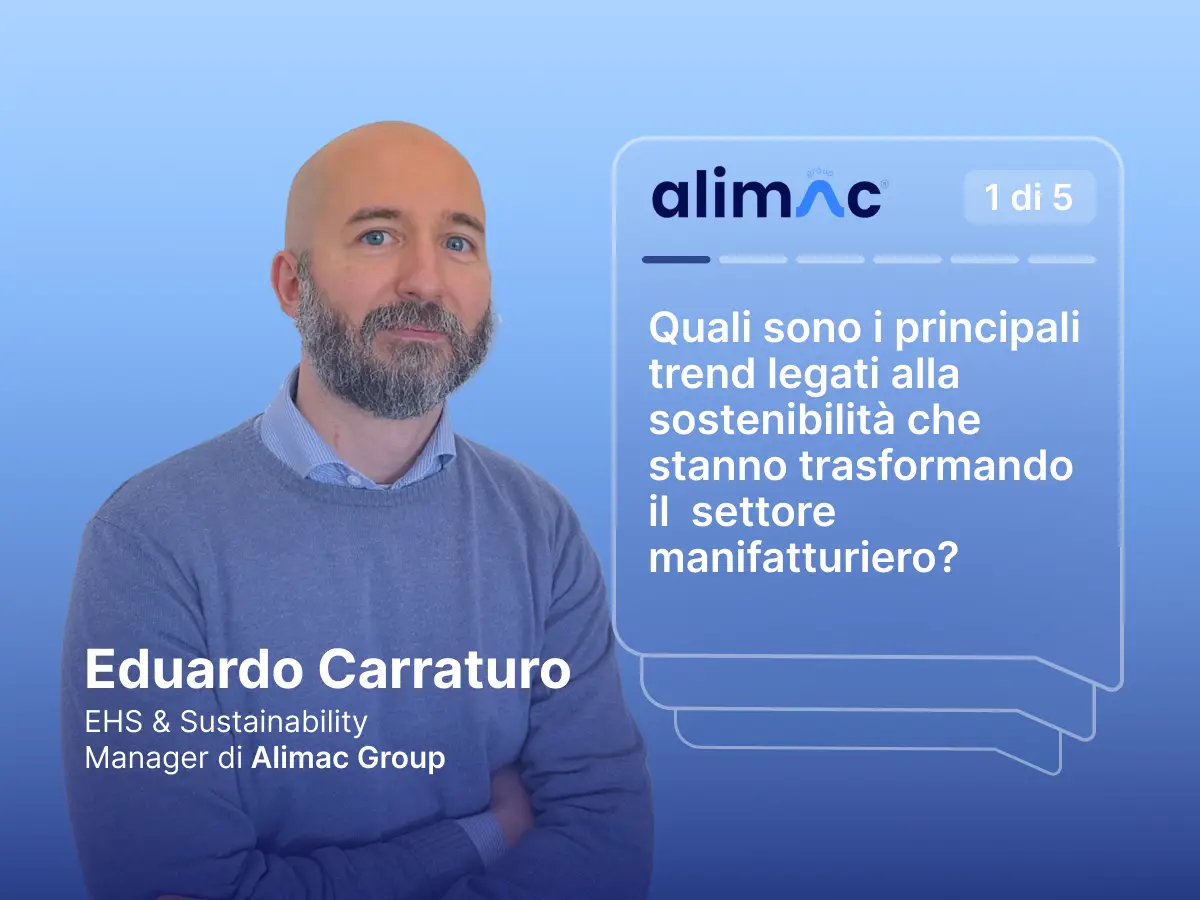
To better answer these questions, we interviewed Eduardo Carraturo, EHS & Sustainability Manager at Alimac, a leading company in secondary packaging solutions, specialized in the production of adhesive handles and innovative packaging systems.

Eduardo, let's start with a general overview. What are the main trends related to sustainability that are transforming the manufacturing sector and, specifically, that of packaging in which Alimac operates?
Sustainability in our sector is no longer just a topic of 'sustainable materials', but a set of precise practices and standards. It means to make clear and measurable impacts along the entire supply chain, from production to the end of life. Today, the sector is driven by very clear dynamics: first of all, let's record a strong pressure from stakeholders, with B2B customers and end consumers who demand sustainable practices and a real reduction in the carbon footprint.
The reason why it is talked about so strongly is linked to a mix of regulatory compliance and competitiveness. Speaking specifically about the packaging sector in which we operate, the introduction of Plastic Tax and of stricter limits on VOCs (Volatile Organic Compounds) pushes us to promote new technological solutions. Large multinational clients, in fact, require strict ESG ratings such as EcoVadis. In short, those who don't evolve stay out of global supply chains.
We must not forget the attention paid to the health and safety on work and the focus on climate impact, which requires improving energy efficiency and reducing carbon emissions. Research and innovation therefore play a key role in creating increasingly performing products and operational efficiency linked to automation, essential for reducing material waste.
Speaking of regulations, the industry is looking closely at the new PPWR. What is the current picture and what will change for businesses?
The data and timing are quite clear: the new European Regulation (PPWR) came into force on February 11, 2025, but its provisions will be binding from August 12, 2026.
The critical element is that the paradigm changes: by 2030, all packaging in the EU market must be recycled in an economically sustainable way. This imposes an obligation to Ecodesign: we must minimize the weight and volume of packaging and limit empty spaces. It is proof that compliance is no longer enough; we need a push towards product innovation that rethinks the entire life cycle.
Companies are often faced with data fragmentation. How can a common language be built that meets both investors and the operational demands of the market?
The main concern for many companies concerns precisely the data governance. It is often realized that shareholder requests and customer requests do not use the same parameters, creating informational short circuits.
Overcoming this phase requires a real process of cultural transformation. In the case of Alimac, the support of Up2You was essential to move from pure calculation to the adoption of a shared method and technical terminology that involved the entire company. Only through targeted workshops and common tools has it been possible to connect the dots and tell the business value in a solid and transparent way, transforming data into a lever for making effective strategic decisions.
When analyzing the value chain, what is the importance of looking beyond company boundaries to understand the real impact of a product?
It's a crucial step. Many companies, calculating their Organizational Carbon Footprint (Purpose 1, 2 and 3), they discover that the greatest impact does not derive from internal activities, but resides precisely in Purpose 3, that is, in the supply chain and in the supply geographies.
Seeing this distribution allows you to shift your strategic focus: it is no longer enough to optimize your plants, you need a different awareness in B2B relationships and with suppliers. Using solid scientific data on the entire supply chain, a company can guarantee a competitive advantage immediate, positioning itself as a structured and reliable partner in the eyes of international investors.
Looking to the future, what are the next standards that companies should start monitoring so as not to be caught unprepared?
You can't stop at simple climate reporting. The next step that we are structuring together with Up2You is the integration of double materiality: analyze not only the company's impact on the world, but also how ESG (environmental, social and governance) risks influence the financial perspective and stability of the company.
In addition, the study of the life cycle of products will become central (LCA) from an ecodesign perspective. Thanks to consultative support, the objective is to anticipate the requests for recyclability and minimization of waste imposed by the PPWR. It is not just a response to a regulation, but an opportunity to evolve towards a resilient and innovative business model, capable of generating value in the long term.
As we saw with Eduardo, the move towards greater circularity does not only respond to a legal obligation, but to the need to build more efficient, aware and resilient organizations, able to stand out in an increasingly demanding value chain.
Although the full application of European provisions is expected in 2026, the complexity of the new requirements, from the minimization of packaging to the accurate reporting of Scope 3, requires companies to immediate planning.
Moving early doesn't just mean being ready for legislative deadlines, but transforming compliance into a strategic asset to improve positioning ESG of the company and consolidate its value proposition in the eyes of global investors and stakeholders.